Everything. Everywhere. All at once.
The Dollar today fell because of Greenland - Treasury yields rose because of Japan

There’s a lot going on in markets today, so here’s a quick post to disentangle things. First, there’s Japan where news of next month’s election caused JGB yields to spike overnight. This pushed up bond yields across the G10 in a kind of “contagion.” Second, there’s President Trump’s escalation over Greenland and his threat to put punitive tariffs on key European countries. This caused the Dollar to fall versus its G10 peers, in a repeat of price action we saw in April 2025 when reciprocal tariffs were unveiled. Third, the S&P 500 fell, weighed down by higher Treasury yields and tariff uncertainty.

The chart above shows Japan’s 30-year government bond yield (white) and the 30-year US Treasury yield (orange). The overnight spike in Japan’s 30-year yield is massive and will obviously exert upward pressure on yields in the US and elsewhere across the G10.
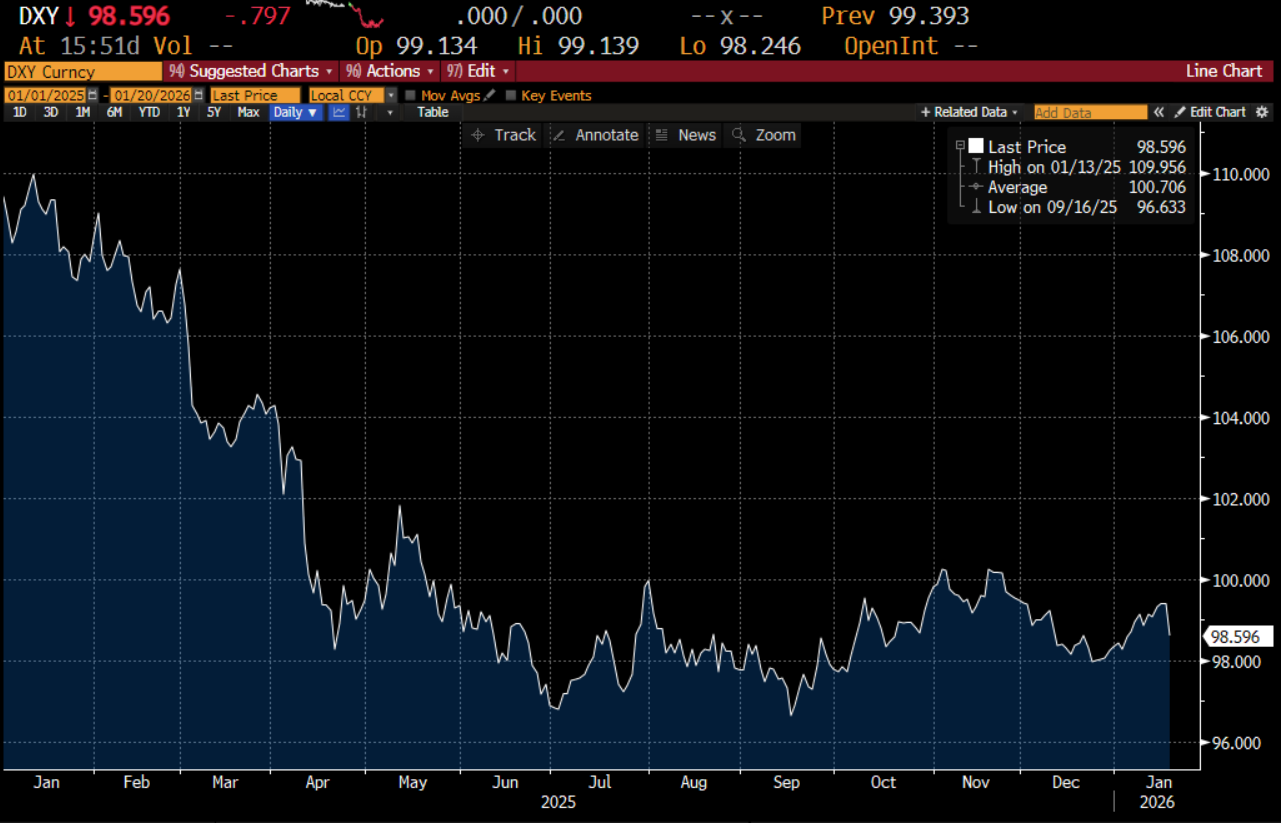
Whatever is going on in Japan can’t explain today’s fall in the Dollar. After all, if Japan is on the brink of a debt crisis, that should cause safe haven flows into the US, which should lift the Dollar. The fact that the Dollar fell is therefore a separate phenomenon and a reprise of price action from April 2025, when the Dollar fell sharply in the face of reciprocal tariffs. The Dollar fall now is similar, though obviously much smaller.
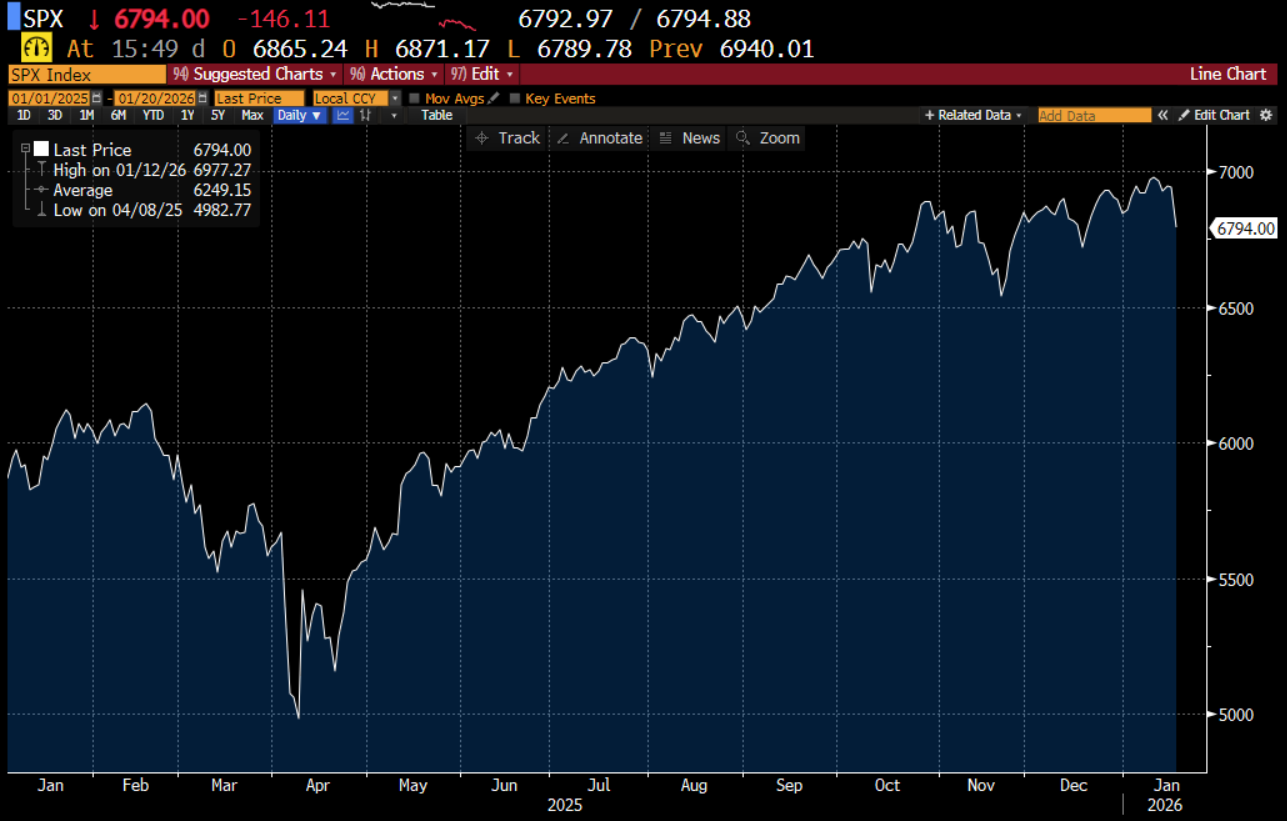
Lastly, there’s the S&P 500, which today was dragged down by the combination of higher Treasury yields (due to Japan) and heightened tariff risk (due to Greenland). As the chart above shows, the two percent fall in the S&P 500 is nothing to write home about and certainty won’t slow the US administration. It would take a much bigger drop - like in April 2025 - to do that.
A couple of points are worth noting after today:
Japan is in very serious trouble. The kind of jumps in long-term yields we’ve seen there are highly unusual. The Bank of Japan will no doubt be called upon to cap yields, but - to do that - it prints money, which will weigh on the Yen. So the Yen is the ultimate victim of Japan’s fiscal dysfunction.
Europe has no leverage over the US. In April 2025, China got the US to back down on tariffs because it has disproportionate leverage over the US Treasury market. Europe doesn’t have that. More importantly, Europe depends on the US to keep Ukraine in the fight against Russia. As a result, European calls to weaponize Treasury holdings aren’t remotely credible.
The debasement trade is powering ahead. Safe haven currencies like the Swiss Franc and Swedish Krona did well today, as of course did precious metals. The combination of geopolitical and fiscal risk is the perfect mix for the flight to safety that’s been playing out since the middle of last year.
US reserve currency status is NOT in danger. The degree of policy chaos in 2025 was much greater than what we have now. Through all of that, reserve managers kept their allocation to the Dollar unchanged. The hurdle for the Dollar to lose reserve currency status is much higher than most people think because there is no alternative (TINA).
The China TACO two-step was due to rare earths, something that no one in the Caligula Administration thought to mention to the emperor ahead of Lib Day. If you think he grasped the implications of China selling (more of) its Treasuries, there’s a bridge in Brooklyn you can buy for a song.
I would disagree that Europe has no leverage.
It can go mad man theory and sanction US tech / destroy transatlantic trade (enormous problems for both side of the atlantic).
But you need the will and courage to pull the trigger and show you’d rather die than submit. And this, the EU won’t do.