I’ve been flagging for many months that we’re in a rolling global debt crisis that pivots from one trouble spot to another. France and the UK were in the crosshairs of markets last year. Now it’s Japan. There’s always idiosyncratic triggers that cause things to boil over at the country level, but - for the world - this puts us on a step function that only ever goes up. This means that long-term bond yields are headed inexorably higher. Today’s post runs through five charts that I think shed light on what’s going on.
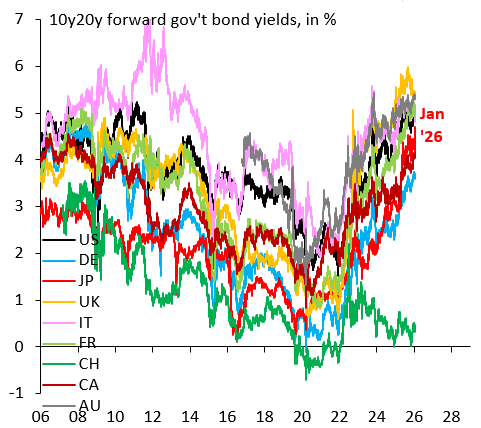
The rise in long-term yields is a global phenomenon. Japan is in focus, but the rise in long-term yields is really much broader. The chart below shows 10y20y forward yields across all key G10 economies. Switzerland (green line) - one of the world’s top safe havens - is the only outlier.
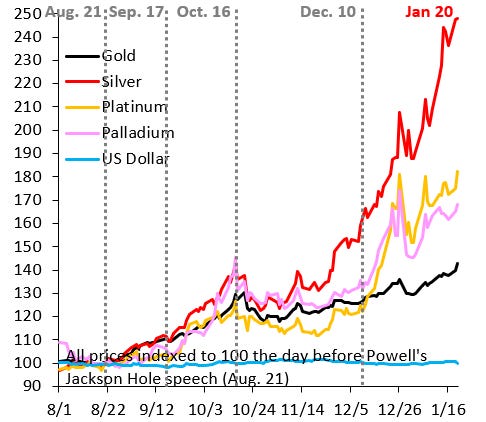
Precious metals are on fire. As the chart below shows, silver is now up 150 percent since Chair Powell’s dovish speech at Jackson Hole on August 22 and gold is up 43 percent. As on many previous occasions when the precious metals bubble goes into overdrive, this is spilling over into platinum and palladium.
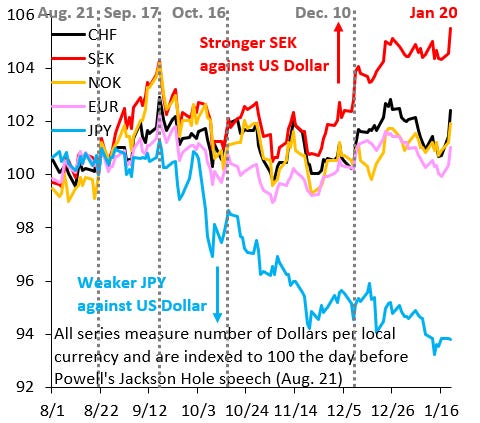
Safe haven currencies rallied hard. The combination of debt sustainability fears and elevated geopolitical tensions drove safe haven currencies like the Swiss Franc and Swedish Krona sharply higher yesterday, as the chart below shows. The hunt for safe havens therefore isn’t just about precious metals. It’s about any and all assets that will protect principal.
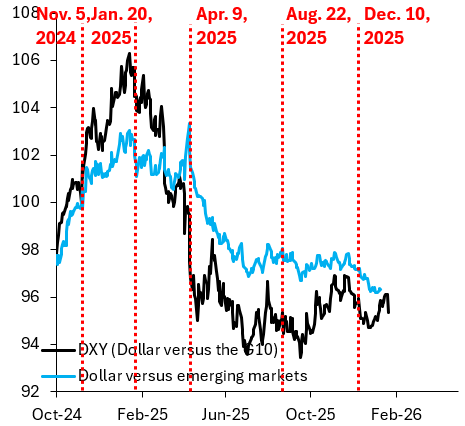
The Dollar is under growing depreciation pressure. I’ve flagged the Dollar versus emerging markets (EM) as a key barometer for Dollar sentiment. As the blue line in the chart below shows, the Dollar has been falling against EM for many weeks. That weakness spilled over into the G10 Dollar yesterday as tensions rose over Greenland.
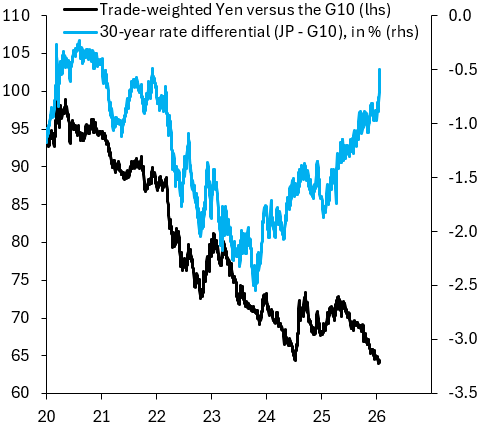
Don’t touch the Yen with a ten-foot pole. When currencies have been depreciating for some time, there’s a natural tendency to want to buy the dip. Don’t do that for the Yen. Japan is in total denial on its debt overhang. That will only change once Yen devaluation gets the government to change course. We’re nowhere near that. As crazy as it sounds, we’re in my opinion only in the early stages of Yen debasement. The decoupling between rate differentials and the Yen - shown in the chart below - has a lot further to go.