
Thank you for subscribing to my posts. If you’re not yet a paying subscriber, please consider becoming one. That’ll allow you to DM me with questions and comments. I plan to move my posts behind a paywall in coming months. Subscribing now locks you in at a low rate. Thank you so much for your support and feedback!
I’ve started dedicating my Sunday posts to four charts that don’t necessarily hang together but that - in my view - are important for what’s going on in markets. Today’s my third post in this series and I’ll start with the bond market sell-off that’s begun to engulf every major economy. I’ll also talk about what it means to have a “Liz Truss” sell-off and how Japan has been trapped in one since 2024.
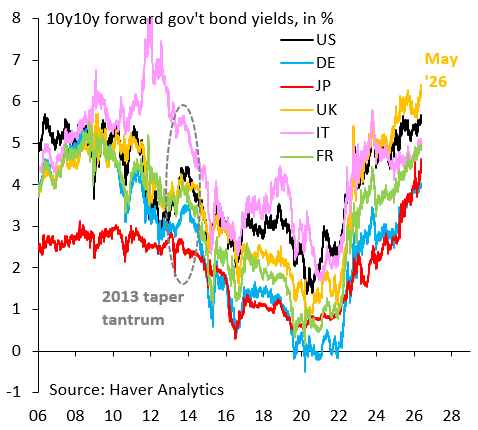
The global bond market sell-off: the chart above shows what’s been going on with longer-term yields in six of the world’s major bond markets. On Friday, the 10y10y forward government bond yield, which I back out from 10- and 20-year yields, reached new highs for the UK (orange) and Japan (red) and rose sharply elsewhere, including for the US (black). The combination of rising inflation and unstable global geopolitics, which means countries need to issue lots of debt to pay for defense, is putting upward pressure on long-term yields. It doesn’t help that yields are being kept artificially low by central banks in some places. This issue is especially acute for Japan and Italy, a problem because it means there’s still lots of upward momentum that’s being bottled up.
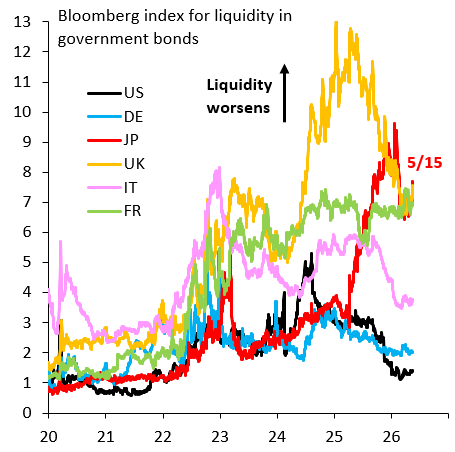
Bond market liquidity is decent: the good news is that bond market liquidity still looks decent, which means you can buy and sell bonds without taking too much of a hit in terms of the bid-ask spread you’re paying. Bloomberg has a proxy for this, which I show in the chart above. This index measures kinks in the yield curve relative to a hypothetical “smooth” curve. The more kinks there are, the worse is liquidity and the higher this index. The US (black) and Germany (blue) look like they’re in good shape. The UK (orange), Japan (red) and France (green) look more worrying, but we’re still at intermediate levels even here. So far, bond markets continue to function relatively well, which means rising yields should - so far - be considered a healthy repricing.
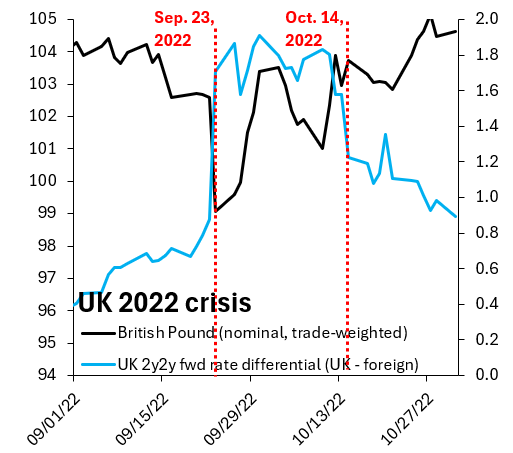
What a “Liz Truss” bond market sell-off looks like: the UK government on Sep. 23, 2022 unveiled a series of measures that boiled down to bigger deficits in the hope of stimulating growth. As the chart above shows, UK yields spiked relative to its main trading partners, lifting the 2y2y forward rate differential (blue line). Ordinarily, this kind of thing would be expected to boost the Pound, but instead it fell, which is a sign that the rise in UK yields had nothing to do with expectations for higher growth and instead was about markets pricing a higher risk premium. It was this risk premium that pushed the Pound lower. This combination - rising yields and a falling currency - is what’s come to be known as a “Liz Truss” sell-off.
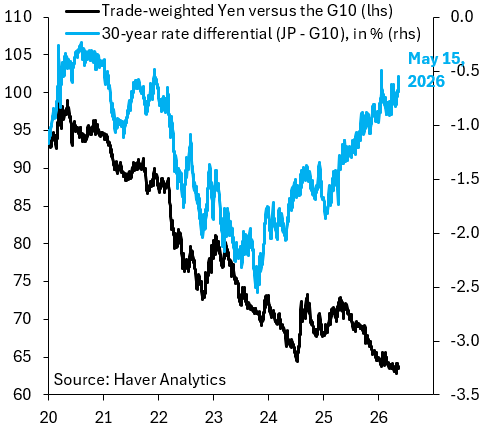
Japan has been trapped in a “Liz Truss” sell-off since 2024: the chart above shows that Japan has been trapped in exactly this kind of dynamic for the past two years. The 30-year interest differential of Japan vis-à-vis its main trading partners keeps rising (blue line), yet the Yen keeps falling (black line). Japan’s current approach of - again and again - using official FX intervention to stop the slide in the Yen just signals the government remains stuck in denial. The way forward is for Japan to sell its ample holdings of financial assets and use the proceeds to pay down its towering public debt. But Japan refuses to do this, which means - in my mind - that the Yen needs to fall further before this denial ends.
Thank you as always for the useful information. It seems that Prime Minister Takaichi and the bureaucrats are fond of CDS. In other words, I think they have little awareness of how critical the situation is and are not paying enough attention to the government bond market. Unless there is pressure from abroad, I think it will be difficult to sell off domestic assets. There are swamps in Japan as well.
All good stuff, BY WHY NOW? Deficits hawks, like you and me, have been sounding the alarm about the unsustainability of ever rising full employment fiscal deficits for years, and occasionally the market spooks, but then goes back to Ostrich behavior. I would love for you to address the "Why Now" and "for how long" questions in a future column. I can't explain it