
Thank you for subscribing to my posts. If you’re not yet a paying supporter, please consider becoming one. That’ll allow you to DM me with questions and comments. Your contribution will help cover the cost of the data I use in my posts, which I fund out of my own pocket. Thanks so much for your support and feedback!
This time last year, I was writing a lot about China. The trade war with the US was at its peak and both sides were dug in. Since then, tariffs have come down on both sides and - more importantly - the China - US trade war has gotten overshadowed by all the other stuff going on, notably the war with Iran and the global debt sell-off.
But just because China’s been off the radar doesn’t mean nothing’s happening. Think about it this way. Imagine you’re a goods producer and sell to one big customer. That customer decides they don’t want to be as dependent on you anymore and announces plans to produce what you make themselves. Nothing’s cast in stone. There could be changes in management that reverse all this. But no matter what happens, you’d be well advised to seek out new buyers, so you’re not beholden to the mood swings of your one big customer. China’s doing this at lighting speed.
Today’s post documents a remarkable spike in Chinese exports to places all around the world. This is most noticeable in smaller emerging markets (EM), where imports from China have in many cases gone vertical. Today’s post shows how crazy things look for individual EMs. Tomorrow’s post follows that up with a look at how this is behind the massive boom in China’s overall trade surplus. While the US and the rest of the world are distracted, China is retooling its export machine. This means China is doubling down on export-led growth, so any hope it might be willing to rebalance growth away from exports is hopelessly naive. Actions speak louder than words.
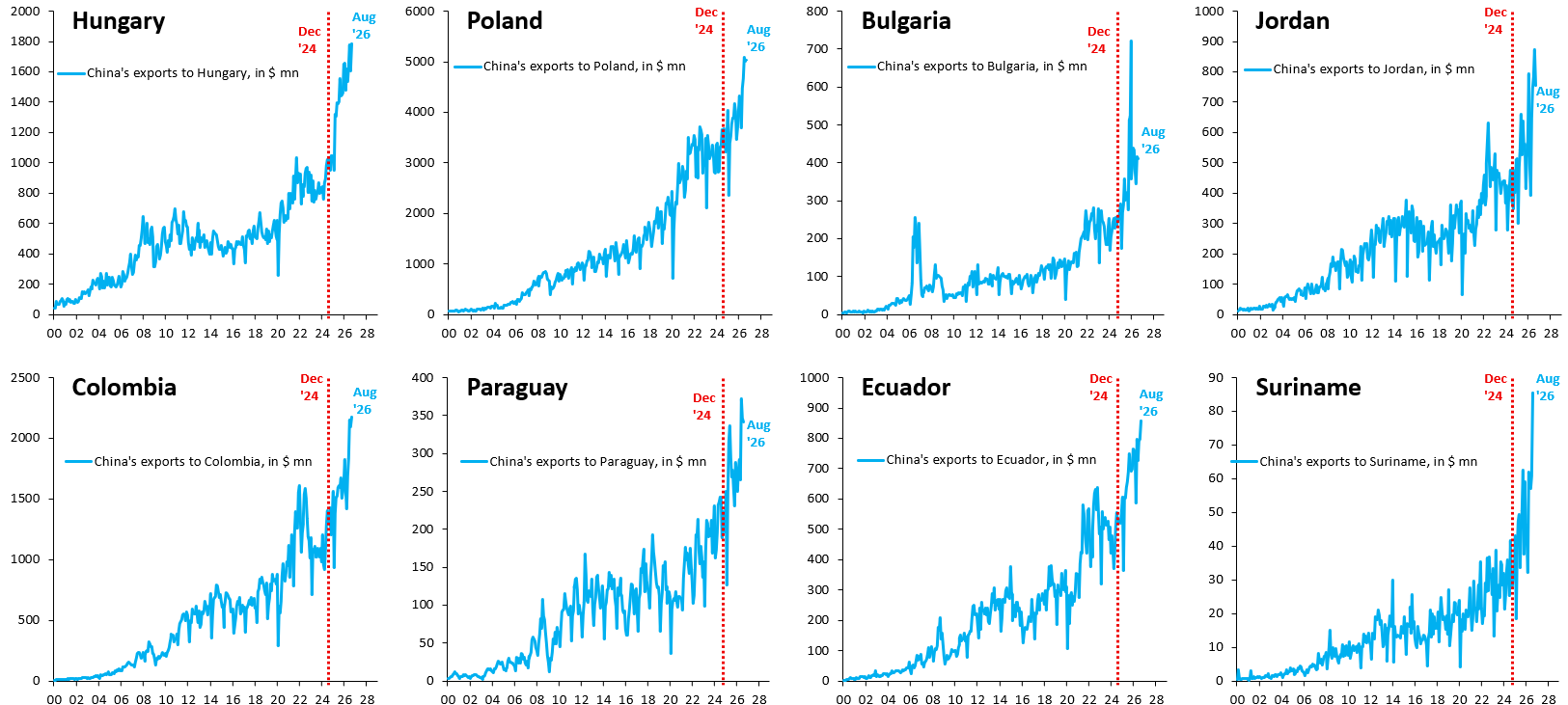
The panel of charts above and the panel below show what’s going on. Each chart has the same format. It shows monthly export values from China to a country. The vertical red line denotes December 2024, the month before the second Trump administration took office. I’m not going to dwell on each of these countries because that misses the point, which is that this is about China and not about the destination countries. China is aggressively repositioning its export machine towards places other than the US, presumably to reduce its exposure in case the trade war escalates again.
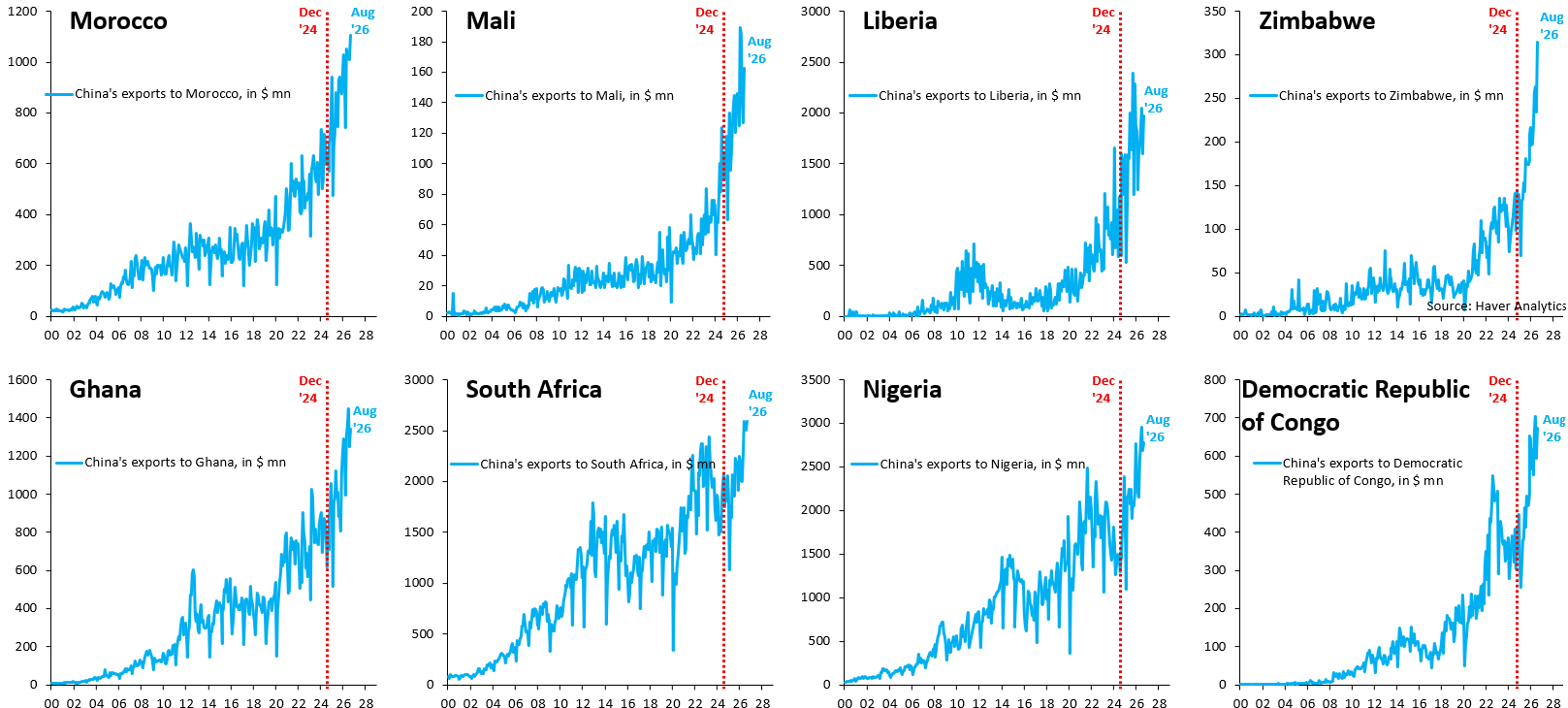
This repositioning isn’t a freebie for China. If you want to export to new markets that weren’t previously buying your goods, you have to discount what you’re selling, so it’s likely this export shift is a hit to margins and profitability in China’s export sector. It’s thus a deflationary shock. But unlike Western countries, China’s leadership is playing the long game and has clearly decided it’s worth taking a short-term hit to reduce vulnerability to US tariffs over the medium term.
All this is of first order importance for the US and Europe. It means imposing tariffs directly on China will wane as a threat over time. In fact, it's increasingly in EM that goods from the US and Europe will get choked off by the deluge of stuff from China, so it’s here policy makers need to focus. If the plan is to build a tariff wall against China, that wall needs to be drawn broadly and include EM. Otherwise US and European producers will get hit no matter what.
What portion of any of these Chinese exports are going through EM markets to the US? The purpose would be to get around direct China tariffs for now.
Seems like for Em countries it would be prudent to create trade barriers against China to protect their local markets.