
Thank you for subscribing to my posts. If you’re not yet a paying supporter, please consider becoming one. That’ll allow you to DM me with questions and comments. Your contribution will help cover the cost of the data I use in my posts, which I fund out of my own pocket. Thanks so much for your support and feedback!
The past week has seen a veritable onslaught on markets by the governments of Japan and the US. There’s been massive actual intervention in foreign exchange markets and and a constant and ongoing drumbeat of verbal intervention, with Treasury Secretary Bessent especially prolific in his efforts to lift the Yen. You’d think - given everything that’s getting thrown at markets - that the Yen would have risen more than during the previous two intervention episodes we saw earlier this year, but that’s not true. Price action is comparable to the NY Fed’s rate check on Jan. 23, which came just ahead of Japan’s Feb. 8 general election. That’s underwhelming and supports my general take that this intervention - like past ones - will fail to stop the Yen’s weakening trend.
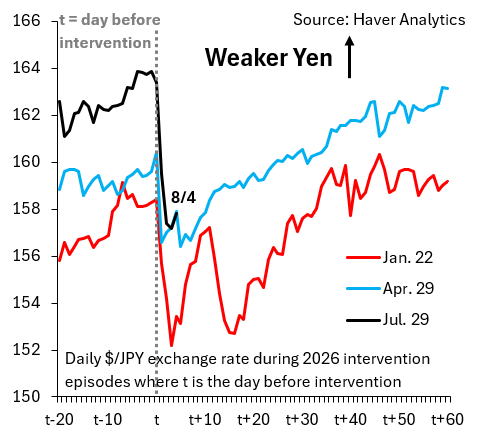
The chart above shows daily data for $/JPY during this year’s three intervention episodes. I’ve lined things up in event time, which means that in each episode t is the day before intervention happens. The vertical gray dotted line marks this day. The red line is $/JPY in the first intervention episode, which is the NY Fed’s rate check on Jan. 23. The blue line is $/JPY in the second episode, which is Japan’s very big, unilateral intervention on April 30. The black line is the current episode, where intervention began on Jul. 30. I’ve denoted yesterday (Aug. 4) as 8/4. Two things jump out from the chart. First, the $/JPY exchange rate drifts higher from one intervention episode to the next. This means that successive interventions failed to arrest the decline in the Yen and underscores my basic point that intervention can’t stop the Yen decline. Second, the drop in $/JPY this time around looks big in absolute terms, but you need to adjust for the fact that it’s happening from a higher level in $/JPY. I do that next.
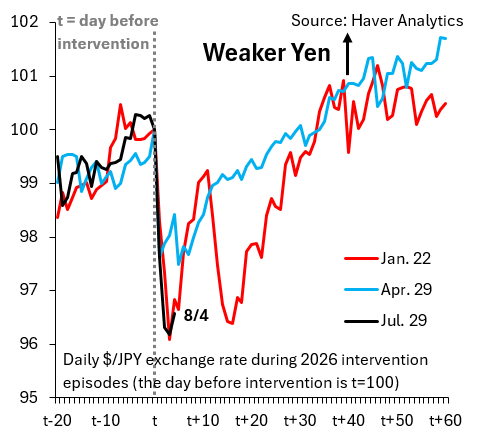
The chart above is identical to the first one, except that it normalizes each of the $/JPY lines to be 100 the day before intervention happens. On this normalized basis, the drop in $/JPY - and the rebound that’s just starting - are almost exactly in line with what happened in January. Given how Japan and the US are throwing everything they can at markets during the current episode, in my opinion that’s pretty underwhelming and supports my general belief that this episode - like all past ones - will fail to arrest the trend decline in the Japanese Yen.
It’s always interesting how you stop short of addressing what would happen if Tokyo finally pulled the plug on its FX activism and started offloading Treasuries/dollars. Bessent made clear the US is doubling down on short-end issuance, with browbeating the Fed into cutting rates the likely lever to keep financing costs down. For that, the US needs a credible buyer. Hence, Japan — the largest holder of the Treasury bag and almost the only buyer left in town. But inflation is biting there, and the yen has been in free fall; naturally, rates need to rise to stem the damage. Yet the Treasury and the dollar would be bludgeoned if Japan hiked and triggered a capital reallocation home. The US wants a strong yen: it narrows the trade deficit and eases pressure on the BoJ to hike — but not higher JGB yields. Japan holds a fleet of foreign assets — a shadow Japan in GDP terms — available to buttress the yen and domestic market. Tokyo has the reallocation button; the US has full faith in Treasury paper and the printing press — the former slowly eroding, the latter already firing on all cylinders.
Question for you: What are the consequences for the US of the Treasury’s intervention to help prop up the yen?