
Thank you for subscribing to my posts. If you’re not yet a paying subscriber, please consider becoming one. That’ll allow you to DM me with questions and comments. I plan to move my posts behind a paywall in coming months. Subscribing now locks you in at a low rate. Thank you so much for your support and feedback!
We’ve come full circle on Iran. Back in March and early April, Iranian oil tankers were freely shipping oil out of the Persian Gulf, even as Western vessels suffered rocket and drone attacks if they attempted to transit the Strait of Hormuz. That made zero sense from a US perspective. Iran’s oil exports are a lifeline for the regime. They are what keeps the economy - which is profoundly broken - from completely imploding.
I recommended we blockade Iran in a post on March 16. What gave me the confidence to make that call was my calculation that - for reasonable assumptions on the closure of the Strait of Hormuz and the price elasticity of demand - the peak in Brent would be around $125, which is pretty much where we were at the time. The risk-reward of a blockade was therefore favorable to the US. It would severely disrupt Iran’s economy and give the regime an incentive to negotiate in good faith, while taking Iran’s oil off global markets would do little to spike oil prices further. This is the logic I laid out on Paul Krugman’s podcast on March 19, which you can see here.
There’s now a strong case to reinstate the blockade, which was lifted almost a month ago. Iran has gained valuable breathing room in this time, exporting record amounts of oil that are giving it access to desperately needed cash. But there’s ways to roll back this breathing room with an enhanced blockade, which would target some of Iran’s oil storage facilities as well as loading berths in the Gulf of Oman port of Jask.
Of course, such a step means we’ll be back to minimal tanker traffic through the Strait of Hormuz, which raises the question of what’ll happen to oil prices. That’s my focus in today’s post. Since my calculation from back in March didn’t factor in the release of emergency stockpiles of oil, it’s robust to the drawdown of emergency inventories like the Strategic Petroleum Reserve (SPR). The peak oil price we should see is therefore still $125 for Brent. If anything, the passage of time in my mind says this number may overstate upside risk to oil prices, because markets have learned a lot of workarounds in recent months to deal with the closure of the Strait.
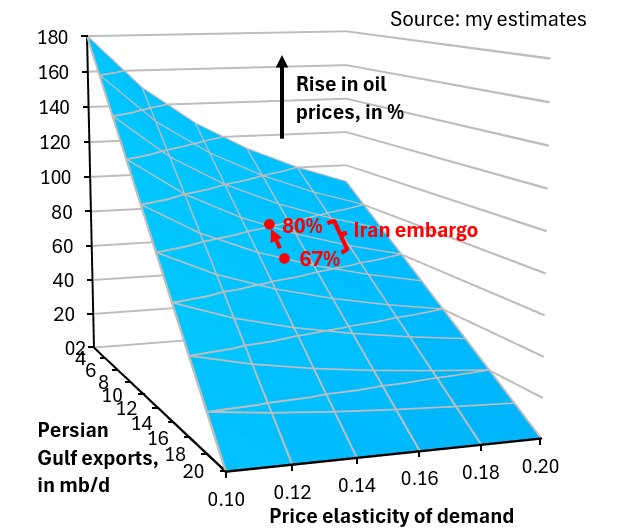
When the supply of oil suddenly drops, prices need to rise to bring down demand. The magnitude of this rise depends on the price elasticity of demand, which describes how much demand falls for a given rise in prices. The chart above is taken from my March 16 post and has the price elasticity of demand on the horizontal axis facing the reader. There’s lots of academic work estimating this thing for oil and the midpoint of those estimates is around 0.15, which means a 10 percent rise in price only sees demand fall by 1.5 percent, which is quite inelastic. The axis angling away from the reader is oil exports out of the Persian Gulf in millions of barrels per day (mb/d). Pre-war exports were around 20 mb/d. A reasonable assumption for what’ll happen if we fall back into a “hot” war is that this number falls to 10 mb/d, factoring in Saudi and UAE pipelines that bypass the Strait and free passage of Iranian oil tankers. The vertical axis shows what this implies for oil prices, which is that they go up 67 percent (the lower red dot). If Iran is blockaded on top of that, this is a further drop of 2mb/d, so exports out of the Gulf fall to 8 mb/d, which takes the required rise in prices to 80 percent (the upper red dot). With Brent back down to almost $70 before the recent escalation, that puts a peak for it in a return to a “hot” war with a US blockade of Iran around $125.
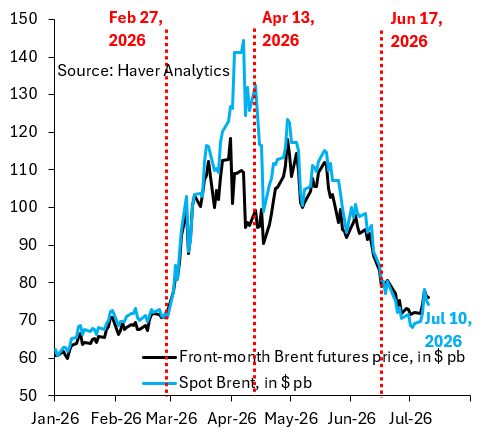
An key thing to note is that my calculations don’t factor in the use of temporary stockpiles like the SPR to cap prices, i.e. they take the drop in supply at face value. This means the depletion of inventories in recent months doesn’t raise the peak for oil prices I’ve calculated here. The fact that temporary supply buffers were in fact used is why Brent spent most of its time below $125, which - as the chart above shows - is true for spot (blue line) and front-month futures (black line) prices. In short, my $125 peak for oil prices isn’t impacted by inventory drawdowns. It just means that prices were lower than they otherwise would have been in March and April because the buffered supply disruption didn’t justify $125 on a sustained basis.
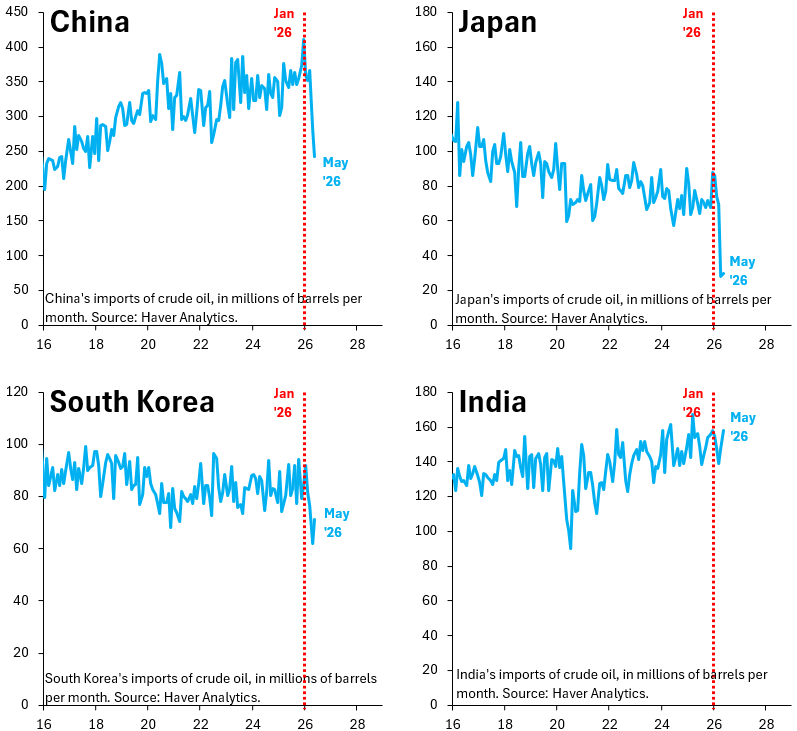
If anything, it’s my sense the peak in oil prices could now be below what we saw in March and April. That’s because markets learned lots in recent months. Workarounds and redundancies were built, so a return to a “hot” war would be less disruptive than it was back in March. The charts above give a sense of this. Countries with large crude stockpiles like China (top left) and Japan (top right) cut their imports a lot. Countries with smaller or no stockpiles scrambled and were able to keep oil imports almost flat, including South Korea (bottom left) and India (bottom right). A lot of the lessons that were learned in recent months will keep oil prices more contained now than during the early stages of this stand-off.
My bottom line is that the risk-reward favors doing a blockade of Iran, much as was the case back in March when I discussed the pros and cons of doing this here. For the two months that it was in place, we know that the blockade did real damage to Iran’s economy. It’s true that Iran gained valuable breathing space since the blockade was lifted, but there’s ways to deal with that, as I outline here. The alternative is to accept Iranian control over the Strait of Hormuz, which I don’t think is - nor should it be - an acceptable way forward.
The post-WWII world order was marked by a US foreign policy of aggressive identity suppression—be it of foe or friend—in order to safeguard its hegemonic position. Among the Axis powers, Japan partially survived the Western purgatory owing to its civilisational and historical heritage, steeped in its language, national pride, and abhorrence of foreign meddling. Germany's fate was different. It was profoundly diminished as a great power, stripped of any meaningful foreign agenda and left with a sole focus on domestic matters—or, at best, pan-European concerns. Having incompetent foreign and defence ministries ergo became the norm in Germany. Kissinger himself was among the principal architects of this hollowing-out of German identity and historical will. The objective was to normalise vassalage among the populace and foster a class of intellectual orphans who regard American leadership as a godly creation. That is why many German worthies—including Mr Brooks—find it arduous to establish a connection between their Germanness—the truism of one's identity and history—and their intellectual opinions, because they were schooled in the art of subordination. Instead, they resort to proxy values or borrow something more nebulous in order to avoid the exercise of identity altogether. Here, the Pan-American liberal order serves as the easy fallback. A land that produced the likes of Luther, Kant, Nietzsche, Weber, and Hegel—and the list goes on—does not require a borrowed identity; it already possesses one of its own. But a nation incapable of articulating the essence of its identity is one destined to perish. That is the lesson the post-war generation of thinkers has failed to grasp.
The previous year also witnessed the emergence of what I call the neo-crusaders: a continuation of the neo-conservatives who beat the drums for the Iraq War and whose intellectual lineage can be traced back to the original crusaders who never relinquished their aspirations in the Levant nor their grievance against the Islamic Empire. Once the time axis is removed, it is as though nothing has changed. Then, the Church, led by Pope Urban II, provided the religious legitimisation and intellectual backbone; today, think tanks and selective ideologues lead the charge. In other words, the warmongers of yesterday are no different from those of today. Mr Brooks wishes to ignore that Iran is rooted in an Islamic civilisation that endured for nearly fourteen centuries and, beyond that, in a Persian civilisation that predates Islam itself. It represents some three millennia of civilisational heritage—a reality that warmongers and intellectual mercenaries alike fail to fathom. And the Afghan debacle should remain vivid in the minds of those who still believe in sweeping wars and blitz victories. Artillery and capital do not provide identity; history does. And Iran possesses an abundance of the latter. The Western bloc took considerable comfort in its post-Sykes–Picot order: fragmenting the Islamic world into compartmentalised states and installing proxy rulers who would ensure the continuity of the colonial project. A case in point is the constant referencing of the Egyptian Pound without a single word about the ruthless military regime that governs the country and its systematic debasing of the currency—a classic example of double standards and selective virtue-signalling. But thanks to Mr Blair, that doctrine has already acquired institutional legitimacy. Whether one is a genuine crusader who believes in this military campaign or merely a chancer seeking to profit from it, one stands on the wrong side of history—and knows it.
Another warmonger here. Does Robin have debilitating bone spurs as well?