How US Tariffs Weaponized China's Exports
US tariffs and resulting export diversion are breeding a new generation of vassal states

Thank you for subscribing to my posts. If you’re not yet a paying subscriber, please consider becoming one. That’ll allow you to DM me with questions and comments. I plan to move my posts behind a paywall in coming months. Subscribing now locks you in at a low rate. Thank you so much for your support and feedback!
One of my biggest peeves is that the popular narrative on places like China, Russia and Iran tends to be much too positive compared to what’s really going on. Just think back to the height of the US tariff stand-off with China this time last year. China was invariably portrayed as having the upper hand in that confrontation, something that I push back on whenever I get the chance. The same is true for Russia, which is stuck in a losing battle in Ukraine and only able to keep fighting because the EU turns a blind eye to the shadow fleet and rampant transshipments. And of course now there’s Iran, which is invariably portrayed as having the upper hand in the war with the US, even as the US blockade is clearly exacting significant damage.
In today’s post, I’m looking at - with the benefit of hindsight - what effect US tariffs had on China. These tariffs were an existential threat to China, whose entire growth model rests on exports. Margins in a lot of the stuff China produces are super tight, so US tariffs had the potential to drive the entire export sector into heavy losses. There was also the more mundane challenge of what to do with all the stuff that could no longer be profitably sold in the US. Global manufacturing operates on a just-in-time basis, so warehouse capacity is minimal.
So what did China do? It exported its surplus stuff to the world’s smallest and poorest countries. Since many of these places are destitute, it’ll have lent them money so they could afford to buy all this stuff, creating a new cycle of dependency. An unintended consequence of US tariffs is therefore that they’ve created a whole new set of vassal states. China always gets its pound of flesh when it sells you something.
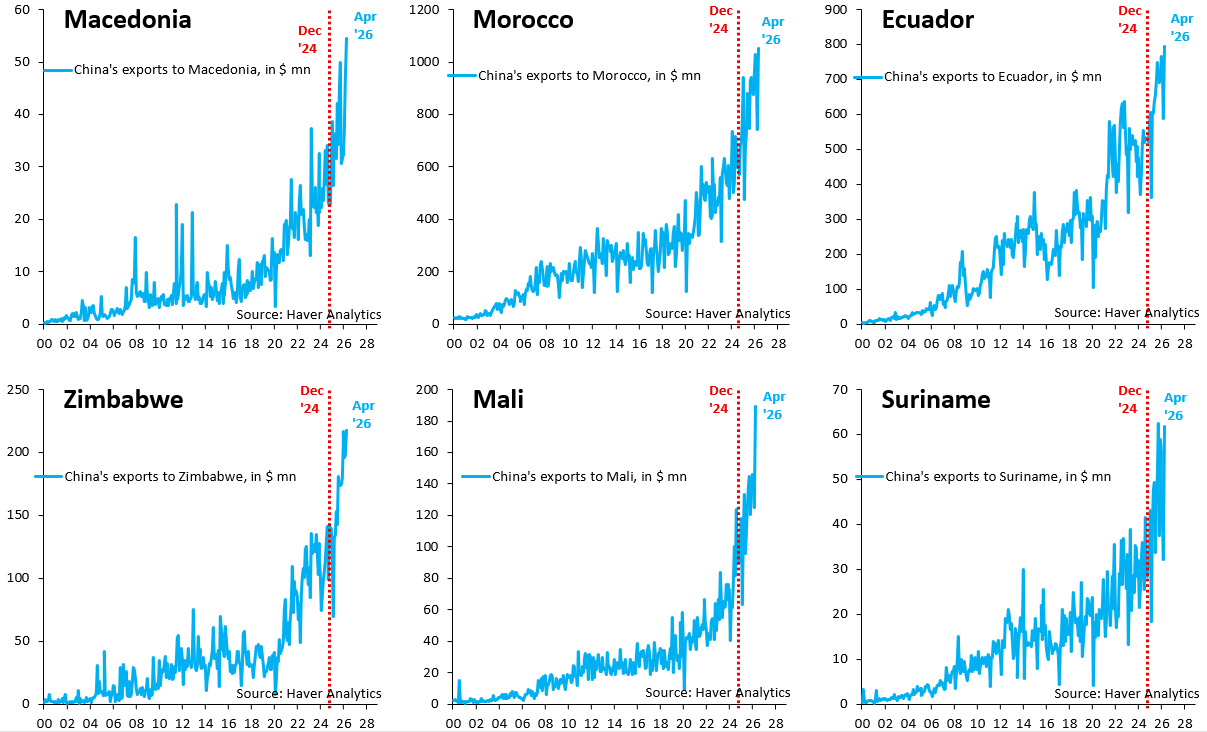
The charts above show monthly data for China’s exports to Macedonia (top left), Morocco (top middle), Ecuador (top right), Zimbabwe (bottom left), Mali (bottom middle) and Suriname (bottom right). In the first four months of 2026, exports to Macedonia are up 80 percent from the same four months in 2024 (I’m not comparing to 2025 because the anticipation of US tariffs was already distorting global trade patterns). They’re up 50 percent to Morocco, 70 percent to Ecuador, 130 percent to Zimbabwe, 150 percent to Mali and 65 percent to Suriname. These are massive increases, which you can see just by eyeballing the charts. The vertical red line is the end of 2024, i.e. just before the Trump inauguration in January 2025.
If this collection of countries seems random, it isn’t. These are tiny countries and - more often than not - they’re quite poor. They’re therefore unlikely to say no when China comes calling, offering lots of stuff with “attractive” financing. This pattern is far less obvious in the big emerging markets, presumably because China doesn’t have the same leverage there. So it looks like this was a deliberate strategy to get two birds with one stone: (i) unload all the excess stuff that could no longer be sold profitably in the US; and (ii) create a new set of vassal states in out-of-the-way places.
You’re probably thinking that these countries - since they’re small - can’t possibly have made a difference given the huge size of China’s exports to the US. But there’s a lot of these small countries and - when you add them all up - they played a meaningful role in absorbing the goods overhang that China had to unload because of US tariffs. Western policy makers will need to have this on their radar screens. All kinds of new dependencies have been created.
We should mention that the Trump regime fought a trade war with the entire world except Russia and North Korea. Even the penguins got taxed, but not Putin.
Also, I see a lot of stressed farm buyouts and bankruptcies DESPITE a bailout. It sure doesn’t look like China’s leverage over the US economy was overblown in places like Arkansas or Montana.
Let’s just admit the obvious: this was about Trump wanting payoffs and butt kisses and not anything resembling coherent, legal, or even sane policy.
Sorry Robin, but I am truly confused by your post.
China's exports in 2025 were $3,776 billion, 5.5% above 2024. The TOTAL GDP (not even imports) of Macedonia, Morocco, Ecuador, Zimbabwe, Mali, and Suriname is $359 billion. Are you really suggesting that China could offset any reduction in exports to the US with exports to those countries? Seriously?