
Thank you for subscribing to my posts. If you’re not yet a paying supporter, please consider becoming one. That’ll allow you to DM me with questions and comments. Your contribution will help cover the cost of the data I use in my posts, which I fund out of my own pocket. Thanks so much for your support and feedback!
The exorbitant privilege is the US’ ability to issue lots of debt at low yields while also enjoying a strong Dollar. You’d think this privilege would be eroding under the weight of endless policy noise and volatility. After all, it’s only a year ago markets were having a big debate on whether the US is losing reserve currency status. Surprise buybacks by the US Treasury are more recent evidence that all’s not well when it comes to funding the debt behemoth that we’re becoming. But - when you look at the US relative to its G10 peers - there’s no sign whatsoever that markets are penalizing the US for any of this. The exorbitant privilege has certainly eroded from a decade ago, but that’s been a longer-term trend that predates the past few years.
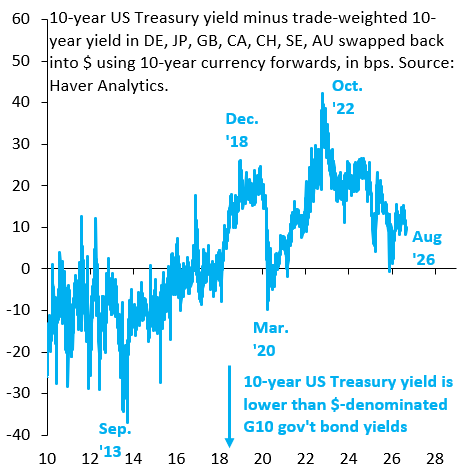
I calculate the differential of the 10-year US Treasury yield minus the trade-weighted average 10-year yield on government bonds in Germany (DE), Japan (JP), the UK (GB), Canada (CA), Switzerland (CH), Sweden (SE) and Australia (AU), where I use 10-year currency forwards to hedge the returns on these government bonds back into Dollars. This rate differential is therefore purely in Dollar terms and thus a good proxy for the “convenience yield,” i.e. whether global markets are willing to buy US debt at a lower yields than debt from other countries because Treasuries are “special.”
The chart above shows a daily time series for this 10-year Dollar differential, starting in January 2010 and going through August 2026. It’s clear that the “convenience yield” on US government debt has disappeared. Where it used to be that the 10-year yield was on average around ten basis points below Dollar-denominated yields in the rest of the G10, there’s now a ten basis point premium. The exorbitant privilege has gone up in smoke, presumably due to US debt rising faster than in the rest of the G10.
At the same time, there’s no sign the policy noise of recent years has caused markets to demand a higher risk premium. If anything, the opposite is true. The risk premium markets demand now is lower than during the Biden years. There’s two explanations I can think of why this might be. First, the fiscal picture outside of the US is worsening as well, notably in Japan and parts of Europe. As the differential is a relative measure, this might make the US look better on a relative basis even if things are getting worse in absolute terms. Second, the US is leaning on markets to cap longer-term yields. In fact, it’s this effort that in my view explains the hawkish keynote by Kevin Warsh at Jackson Hole, as opposed to any genuine desire to hike. A new Treasury-Fed accord is taking shape, with the overriding objective of keeping long-term yields anchored as debt and deficits run out of control. It’s possible this is pulling down my differential, in which case this is yet another manifestation of actual yields decoupling from “shadow yields,” i.e. what yields would be without government interference.
The fact that markets don’t price a meaningful fiscal risk premium really worries me. After all, if markets don’t send such a signal, policy makers have no incentive to make needed changes. Things will have to get worse before they can get better.
There is interesting research into the 'exhorbitant privilege' by the BIS. They found no monetary advantage - be it a convenience yield or otherwise - nor disadvantage. Btw I have not seen any serious research backing up the negative take that it, by itself, forces upon the US dissaving, current acc deficits, debt and a loss of manufacturing.
However, it seems to provide a large liquidity advantage, ie it is easier to issue debt and refinance. In that sense the US is blessed and can run imbalances much farther than anybody else. So it is no surprise that Trump' tariffs, the deficits and the war have not produced what many predicted: US debt is not being liquidated, USD denominated CB reserves are down marginally, the USD has not collapsed etc. The reason is that we are discussing relative prices. The other side of 'relative' is a non-convertible Yuan, a EZ that has no ambition as to commodity pricing and payments (even within Europe) or safe asset markets or any kind of international role for rhe Euro (which comes with obligations), irrelevant GBP and SFR and commodities which are being touted as all sorts of debasement trade tools (gold, silver) but are, in reality, priced, paid in USD.
The US is on a totally unsustainable fiscal path, is largely interventionist (as opposed to market based) in its monetary policy, has an incompetent administration and is prone to bubbles/ bursts. But there is a positive gap with all others in terms of real growth. Now the issue is that the gap on real interest is debatable because rates are supressed. So there will be either an adjustment of NGDP down or 10 yr UST up. What the exhorbitant privilege (and some technical factors) does is to leave the US more time for adjustment. But the negative arbitrage between NGDP growth and 10 yr yield will close. It will neither be a debasement trade nor the end of USD dominance if the real growth gap persists. It will be more difficult if it doesn't.
Sorry but your analysis is incoherent and myopic or it is incoherent because it is myopic. It is incoherent because you say yourself that, contrary to what you claim in your conclusion, markets DO send a signal to the US (and other countries): 'the differential is a relative measure' which might make the US look better on a relative basis even if things are getting worse in absolute terms." It is myopic because you don't seem to understand that the problem is almost certainly systemic and not a question of 'policy'. The post-1971 global and epic credit boom is doomed to either end with an epic and global deflationary bust (without meaningful intervention to sustain it and its disfunctional emanations, à la GFC, and/or with the implementation of the kind of fiscal/austerity policies which you portray as 'sound') or with some kind of inflationary/stagflationary quagmire (financial repression). We cannot navigate between the Scylla of deflationary debt destruction and the Charybdis of inflationary debt relief. Except maybe, with the help of an AI deus ex machina.