
Thank you for subscribing to my posts. If you’re not yet a paying supporter, please consider becoming one. That’ll allow you to DM me with questions and comments. Your contribution will help cover the cost of the data I use in my posts, which I fund out of my own pocket. Thanks so much for your support and feedback!
There’s general consternation - after the truly massive intervention at the end of July and the helping hand from the US - that the Yen has resumed its weakening trend so quickly. That’s actually par for the course. In Japan’s long history of FX intervention, there’s never been an instance where this has changed the path of the Yen. The only case where Japan has - by its own means - changed Yen direction involved a radical change in policy at the the Bank of Japan (BoJ) with the arrival of Haruhiko Kuroda, whose aggressive “quantitative and qualitative monetary easing” (QQE) flattened Japan’s yield curve, causing the Yen to fall after many years of appreciation.
This highlights what’s needed now if the objective is to stabilize or even strengthen the Yen. Intervention won’t do the trick. It’ll be just as ineffective as in the past. Hikes in the overnight policy rate won’t work either because the front end of the yield curve is largely irrelevant for the Yen. What Kuroda showed with his arrival in 2013 is that it’s the BoJ balance sheet and - in that case - duration withdrawal that matter. If Japan wants to stop the fall in the Yen, it’s now got to do the opposite, i.e. slow BoJ bond buying and inject more duration into the market. That’ll push long-term yields up toward their “shadow yield” levels, which will lift the Yen.
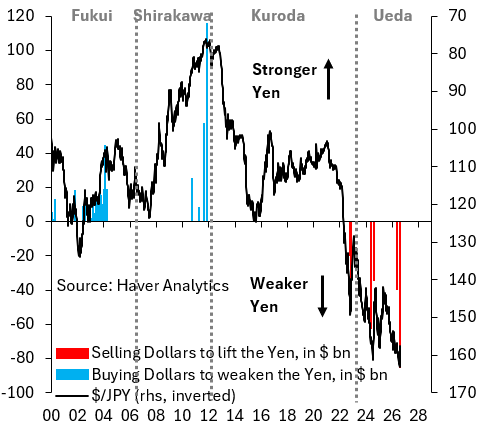
The blue bars in the chart above show Japan’s intervention to weaken the Yen (which means buying Dollars and selling Yen), while the red bars show recent intervention to strengthen the Yen (selling Dollars and buying Yen). The black line on the right axis shows the $/JPY exchange rate on an inverted scale, so a downward move in this line means the Yen is weakening against the Dollar. The vertical gray lines denote changes at the top of the BoJ. Critically for this discussion, Kuroda became Governor in March 2013, whereafter he instituted aggressive purchases of government debt to flatten the yield curve. As the chart shows, Japan’s repeated attempts to stem the strengthening trend in the Yen prior to Kuroda’s arrival were ineffective. Instead, it took a big shift in BoJ policy to alter the trajectory of the Yen.
The run-up to 2013 is an important lesson for now. Kuroda successfully reversed many years of Yen appreciation by shifting BoJ policy to aggressively flatten the yield curve. The reverse is now needed if the Yen is to stabilize or strengthen, which means the BoJ needs to cut it purchases of government bonds - now running at an annual pace of around four percent of GDP - and inject more duration into the market. That’ll allow longer-term yields to rise towards their “shadow yields,” i.e. where these yields would be without BoJ bond buying. That will strengthen the Yen.
Have you talked to Brad Setser on this? I heard a different take from him in a recent Odd Lots interview (most pertinent part is at the last 7 minutes). He'd agree that the value of the Yen hangs on BOJ raising rates, but he otherwise has some unorthodox views on Japan. I'd love to hear/read you two discuss it.
Hi Robin. very interesting as always. one thing i've wondered about: how can the BOJ keep doing things that burn cash? aren't they buying bonds that keep going down in value? where are the losses? how can their cash flows support this?