
Thank you for subscribing to my posts. If you’re not yet a paying subscriber, please consider becoming one. That’ll allow you to DM me with questions and comments. I plan to move my posts behind a paywall in coming months. Subscribing now locks you in at a low rate. Thank you so much for your support and feedback!
It was Winston Churchill who said: “Democracy is the worst form of government except for all the others.” Pretty much the same is true for oil futures. They’re far from perfect, but they’ve outperformed - substantially - commodity analysts who catastrophized this oil shock and also the one in 2022 after Russia invaded Ukraine. Many of the people who make such forecasts are really lobbying on behalf of the global oil sector, which hates any kind of interference in its ability to make money. Stratospheric oil price forecasts aim to scare the US into backing down in its current standoff with Iran, much as they aimed to prevent the G7 oil price cap on Russia from happening back in 2022. Futures have no such bias. Of course, they can still be wrong, but that’s true of FX forwards or interest rate futures as well. People who dump on oil price futures don’t seem to do much forecasting themselves. If they did, they’d know better.
In today’s post, I run through the war with Iran as well as Russia’s invasion of Ukraine and document that futures did MUCH better at predicting oil prices than apocalyptic forecasts from the analyst community. One common mistake I see is to compare the unconditional track record of futures with ensuing oil prices. That’s wrong. You want to avoid mixing up demand and supply shock and compare like-for-like. In the current setting, this means looking at supply shocks that are war-induced. This is how I end up with 2022 and the current episode. In both instances, futures clearly outperform the alternatives.
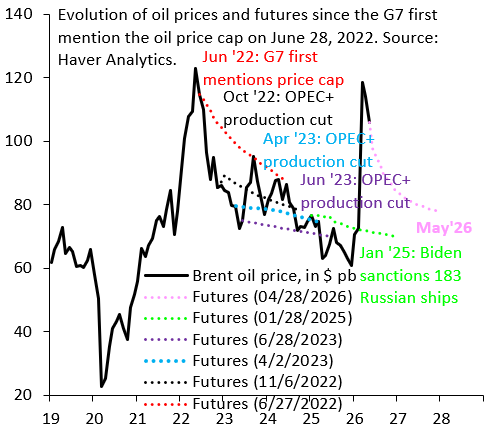
Let’s look at 2022. The black line in the chart above shows the front-month Brent futures price and futures curves at different points, including Jun. ‘22 (red line) when the G7 oil price cap first made its way into the press. At that point, the futures curve was downward sloping and oil prices did indeed end up falling. That’s in contrast to many apocalyptic oil price forecasts at the time, including one that had Brent going to $380 per barrel. Futures very clearly outperformed the alternatives during that shock.
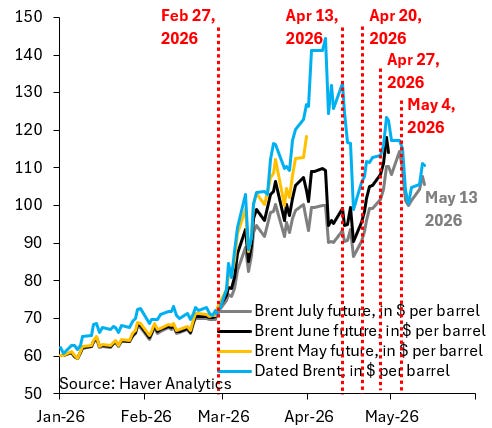
The second example is what’s played out in recent months. In the first weeks of the war, as the chart above shows, Dated Brent rose far above front-month futures prices, a development that was accompanied - much like in 2022 - by forecasts going all the way up to $200. The gap closed not because futures rose to meet “spot” oil prices, but vice versa. The horse race between “physical” and “paper” oil prices was won decisively by the latter, which means futures prices once again outperformed the alternatives.
In my opinion, there’s a good reason why futures outperform commodity analysts in war-induced supply shocks. Apocalyptic oil price forecasts are really about industry lobbying and intended to scare Western policy makers from interfering too much in the oil sector. That’s why futures do better. This isn’t to say they always do better, but - conditional on a war-induced supply shock - they outperform “biased” analyst forecasts that aren’t actually about predicting the future.
Very good I thought. Warmest thanks. Ian
Onyx is the largest liquidity provider in Dated Brent, the benchmark underpinning most global physical crude oil pricing. The Onyx Spot Return Crude Oil ETC is currently the only ETC providing public access to Dated Brent exposure, rather than relying solely on futures-based products.