
Thank you for subscribing to my posts. If you’re not yet a paying supporter, please consider becoming one. That’ll allow you to DM me with questions and comments. Your contribution will help cover the cost of the data I use in my posts, which I fund out of my own pocket. Thanks so much for your support and feedback!
Today’s post summarizes the key questions I’ve gotten in recent days on intervention to lift the Yen and whether it’ll be successful. My basic view is that intervention can’t possibly hope to stem Yen depreciation in the medium term, because that is driven by Japanese government bond yields that are being capped by the Bank of Japan (BoJ) to prevent a debt crisis. Only higher yields can stabilize the Yen sustainably. Japan can’t afford those and there’s nothing FX intervention - even with US involvement - can do to change that.
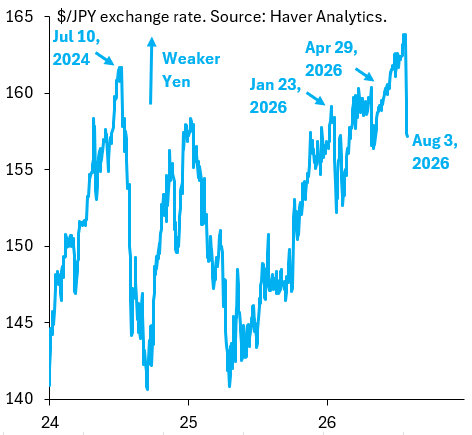
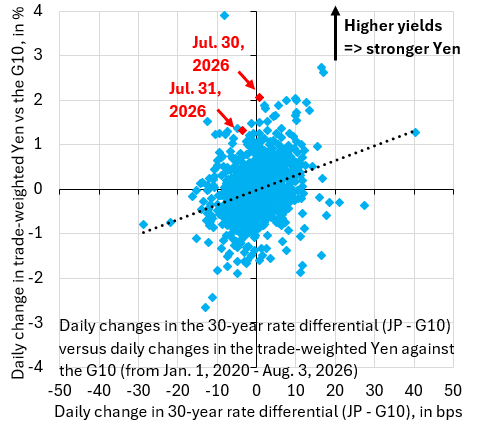
When is FX intervention successful? There’s three conditions when intervention to strengthen a currency can be successful: (i) speculative shorts are so stretched that official intervention inflicts heavy losses and changes the market narrative; (ii) the currency is materially undervalued - which means it’s disconnected from fundamentals - so that intervention can help nudge things back to equilibrium; and (iii) the central bank raises interest rates so that monetary policy is pushing the currency in the same direction as the intervention. On the surface, as the chart above shows, the latest round of Yen intervention looks successful, but this picture is deceptive because none of the three conditions are met. As I noted in Sunday’s post, speculative shorts are sizeable but not yet extreme by historical standards. The Yen is - if anything - overvalued, so this condition isn’t met either. And lastly, as the chart below shows, recent strengthening in the Yen happened even as the 30-year rate differential was either unchanged (Jul. 30) or actually moved against the Yen (Jul. 31). The BoJ isn’t giving any kind of assist.
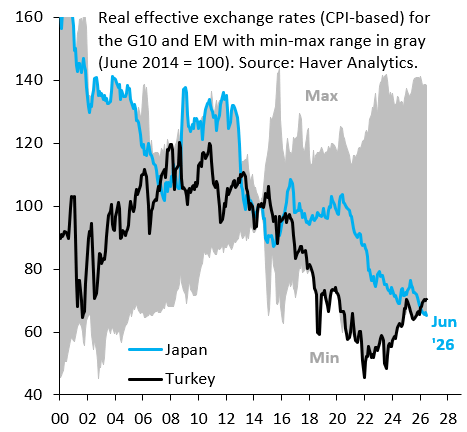
What is currency undervaluation? This might sound like a silly question, but it isn’t at all. As the chart below shows, the real effective exchange rate of the Yen (blue line) has fallen for many years. It’s tempting to think this makes the Yen undervalued, but that logic is flawed. After all, the Turkish Lira (black line) has fallen for many years as well and much of its fall is permanent. Just because you’ve fallen for many years in no way guarantees a rebound, i.e. a reversal of undervaluation. In the case of the Turkish Lira, Erdogan’s unorthodox policies have taken a permanent toll. In the case of Japan, artificially low government bond yields mean the currency is overvalued, not undervalued.
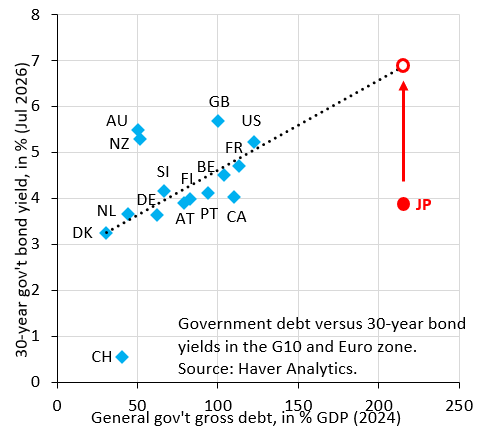
Is the Japanese Yen undervalued? No, it definitely isn’t. If anything, the Yen is overvalued, as crazy as that sounds. This is because Japan’s long-term government bond yields are below where they should be, thanks to ongoing, large purchases of public debt by the BoJ. As a result, Japan’s shadow yield - what the 30-year yield would be without BoJ caps - is at least 300 basis points above where it actually is, as the chart below shows. This artificial suppression of the fiscal risk premium generates constant outflows from Japan, which put depreciation pressure on the Yen. The fact that the risk of official intervention exists prevents the Yen from moving quickly to a level that prices this fiscal risk premium, which makes it overvalued.
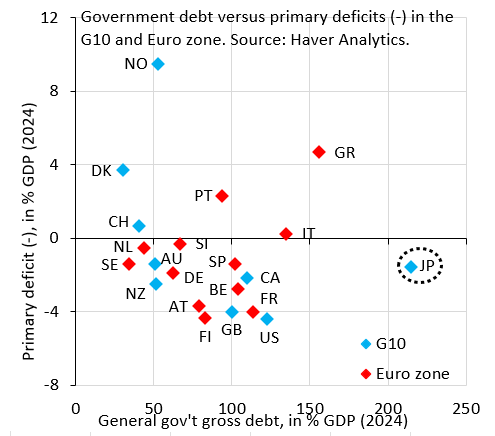
Japan’s primary deficit is small, how can fiscal policy be the problem? The chart below shows the primary deficit (when negative) on the vertical axis and gross public debt on the horizontal axis. Japan’s primary deficit isn’t as large as that of other countries - notably the US - but the stock of debt is also way higher. Japan should really be running a primary surplus to bring debt down, but it’s unable to do that. Fiscal policy is definitely the problem and nowhere near good enough.
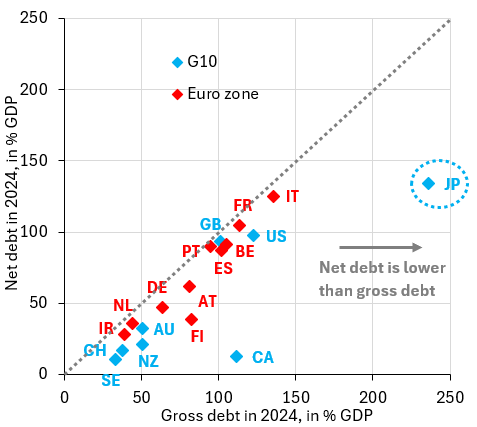
So what should Japan do? As I flagged in a post last year, Japan’s net debt is a lot lower than its gross debt. The difference is financial assets, which can be sold to pay down gross debt. As the chart below shows, no other advanced economy comes anywhere near Japan on this dimension. Even a small sale of government assets - say ten percent of GDP - would get huge recognition in markets and would help strengthen the Yen without needing to let bond yields rise. The current political equilibrium is still one of denial on this however, which is why in my opinion the Yen will ultimately resume its march towards $/JPY 180.
Could you enlighten me in terms of the amount of Japanese government asset that is available to sell? It looks like that there are not a lot and may not be possible to sell e.g. roads and bridges, as the Japan MoF puts it. It would be very helpful if you could shed some light on this.
Robin Brooks is spot on in the diagnosis of disequilibrium in the foreign exchange market with Japanese Yen on a path to devalue against the U.S. dollar and other foreign currencies. The unconventional monetary policy of BOJ keeping longterm yields of JGBs too low for too long has caused this disequilibrium and it is now unwinding. I agree with Brooks that the unwinding of it will further continue in defiance of the joint intervention by the U.S. Treasury and Japan’s Ministry of Finance.