
Thank you for subscribing to my posts. If you’re not yet a paying supporter, please consider becoming one. That’ll allow you to DM me with questions and comments. Your contribution will help cover the cost of the data I use in my posts, which I fund out of my own pocket. Thanks so much for your support and feedback!
The recent attack on the East-West pipeline has given the false impression that Saudi Arabia is on the back foot in this war. That’s not true at all for two reasons. First, Iran has always been the Kingdom’s main rival in the Middle East. However and whenever this war finally ends, Iran will emerge massively weakened and dependent on foreign aid in its efforts to rebuild. Second, Saudi Arabia never saw its oil exports fall to zero at the height of hostilities back in March and April, thanks to the East-West pipeline that circumvents the Strait of Hormuz. At the start of 2026 - before the war started - the Kingdom exported around 7 million barrels of oil per day (mb/d). At the height of the conflict in March and April, this fell to just below 4 mb/d. This month - even with the attack on the East-West pipeline - we’re averaging around 5.5 mb/d because ship traffic through the Strait of Hormuz has picked up massively under protection from the US Navy. Brent is up 75 percent since early 2026, so - once you model all this out - Saudi Arabia is reaping a windfall north of 6 percent of GDP in terms of higher oil export revenues. The longer this conflict lasts, the better for Saudi Arabia.
The reason this matters is because Saudi Arabia obviously isn’t an impartial bystander in this conflict. The Wall Street Journal this week had a good article on the Saudis and UAE lobbying the US to stay tough on Iran and - no matter what - keep the blockade in place. There’s good reasons to stick with the blockade, which I’m strongly in favor of. Iran’s economy is imploding, with its currency - the Rial - in freefall, something I covered extensively in a recent live stream. But it’s important to know when people are “talking their book.” The Saudis and the UAE clearly are. If anything, they should be made to contribute meaningfully to the cost the US is bearing to ensure safe passage for oil tankers through the Strait of Hormuz.
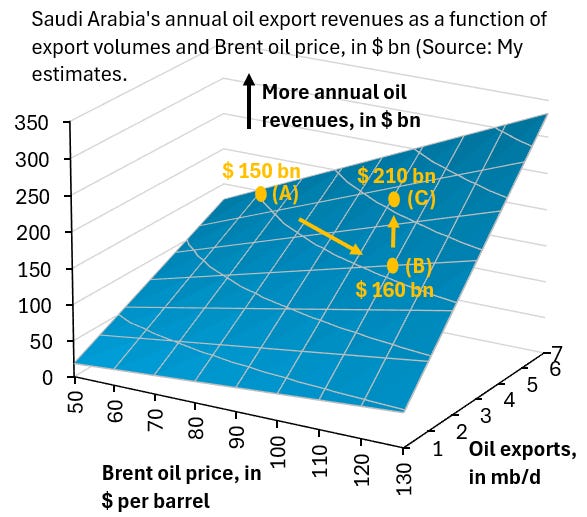
The chart above shows how the Brent oil price (horizontal axis nearest the reader) and export volumes (horizontal axis away from the reader) map into Saudi Arabia’s annual oil export revenues (vertical axis). For Brent, I assume a range of $50 to $130, while for export volumes I set a range from 1 to 7 mb/d. The first orange dot is export revenues before the war. I’m calling this dot (A) and it corresponds to export volumes of 7 mb/d and Brent at $60. This maps into annual revenues of $150 billion. The second dot - (B) - is the height of the war in March and April when the Kingdom depended entirely on the East-West pipeline. Exports were around 4 mb/d with Brent around $110, so export revenues were $160 billion at an annualized pace at this point. Higher oil prices more than offset the fall in export volumes. The third dot (C) is where we are now. Exports are at 5.5 mb/d with Brent near $105. This implies annualized export revenues of $210 billion, i.e. a $60 bn rise from before the war. Nominal GDP has averaged around $1 trillion in recent years, so that’s a windfall worth 6 percent of GDP.
If you’re curious how strong Saudi Arabia’s position is, consider this. At the current pace of export volumes - 5.5 mb/d - Brent would have to fall meaningfully below $75 for Saudi Arabia to be worse off than before the war. The Saudi Kingdom is perhaps the only winner in this war.
With all due respect. No one will ever know the outcome of the war until it’s done. We have not been winners in wars since the Second World War.
But what strikes me in your article is the bias towards Trump’s position which is not the US population position. Being an American myself I would never ask a country being hammered daily and its economy and prestige being shaken (no matter whether it is damaged more or less than Iran) to foot the bill of a war we started with Israel. What an imperialist position that shows the ugly face of our country. Over the years we have armed Saudi Arabia with the stealthiest weapons we have at a cost of hundreds of billions of dollars. Even today Congress is about to approve a request for multiple F-35 fighter planes generating billions of dollars to our economy. Yet you are insinuating that they should also foot all the bill. The motive of the war if I listen to our President is to stop it from having a nuclear weapon for us and for our allies, European or Israel? Then our President suggested we take Iran’s oil. Is there something that you or our President don’t want to take from the Middle Eastern countries under the guise of protecting them, when Israel is the only threat to them, has been and will be (of course thanks to us again). I think you owe the readers and your fellow Americans an answer.
With Mocha captured Bab el-Mandeb plus the islands under Houthi control,the Houthis could keep the noose tight and keep the Saudis choking for a long time.
This follows six Houthi ballistic missiles intercepted on Thursday, showing that the attacks on Saudi Arabia are continuing rather than being an isolated incident.
So how can you say Saudis are winning!!!!