
Thank you for subscribing to my posts. If you’re not yet a paying supporter, please consider becoming one. That’ll allow you to DM me with questions and comments. Your contribution will help cover the cost of the data I use in my posts, which I fund out of my own pocket. Thanks so much for your support and feedback!
One of the biggest market questions out there is how much higher Japan’s long-term government bond yields would be if the Bank of Japan (BoJ) weren’t constantly buying government debt to cap them. In yesterday’s post, I used data on yields and debt levels across the G10 to estimate that Japan’s 30-year yield might be 300 basis points higher, i.e. seven instead of the four percent we observe, but - honestly - I see this as a wildly conservative estimate. If the BoJ announced an end to its role as a backstop for the JGB market, yields in my opinion would go into double digits in no time.
The issue of central bank yield caps is pervasive across the G10. It’s a major concern in the Euro zone, where the ECB in 2022 enthusiastically capped Spanish and Italian yields via bond market interventions and rolled out a new tool - the TPI - to cap yields on a more permanent basis going forward. Indeed, central bank buying of government debt has become the norm across all of the G10 in recent years. What was portrayed at first as a cyclical tool to provide additional monetary stimulus when policy rates near zero has become a permanent source of funding for governments, because debt that’s bought is never sold when whatever bad shock prompted QE in the first place fades.
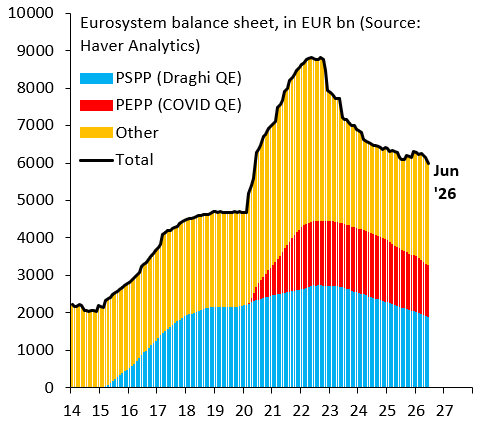
Conceptually, central bank activity artificially depresses government bond yields via three channels. First, there’s a “flow” effect, which is purchases of government debt in the secondary market, which help keep yields lower than otherwise. Second, there’s a “stock” effect, i.e. the cumulative impact of past purchases and - when holdings are de facto rolled over indefinitely - how much this holds down yields artificially. And third, there’s all kinds of verbal intervention and precedent created by past actions, which creates in markets the expectation that central banks will intervene when bad shocks hit and blow out budget deficits. President Lagarde’s repeated pronouncements on the French bond market belong in this category, as does the creation of the TPI. The chart above shows the balance sheet of the ECB. Government debt that got bought under Draghi (blue) and then during COVID (red) is permanently warehoused. Any effort to meaningfully run down these holdings would spark crises in high-debt countries.
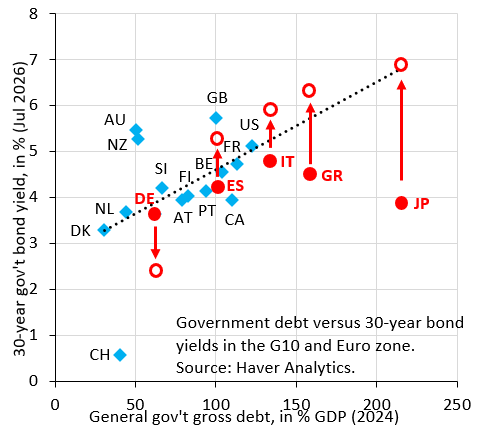
The scatter plot above shows my estimates for what 30-year shadow yields are for Germany (DE), Spain (ES), Italy (IT), Greece (GR) and Japan (JP). The solid red dots are actual yields in markets as of yesterday, while the hollow dots are where I think yields would be if central banks pulled back from yield caps. In the case of Japan, this would be an end to gross purchases of JGBs. For the ECB, it means cancelling TPI and going back to the OMT as the only bailout facility. It would obviously also preclude the kind of comments President Lagarde is fond of making on French yields. I don’t anticipate actual selling of government bonds from anyone, so my shadow yields are a lower bound for how high yields might go if central banks really exited bond markets.
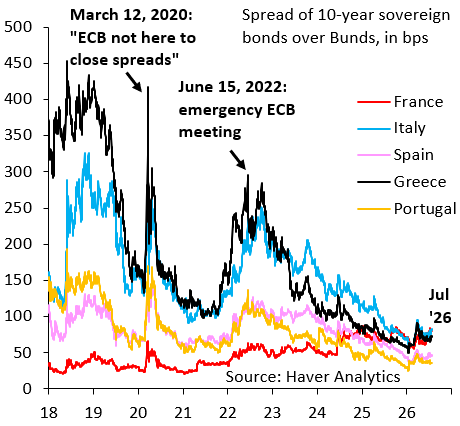
I outlined how I derive my shadow yields in yesterday’s post, so I’ll focus on my key messages today. My shadow yield is 300 basis points above the actual yield for Japan, 200 basis points above for Greece and 100 basis points above for Italy and Spain. My shadow yield for Germany is 100 basis points BELOW observed yields. This is because ECB actions to cap yields reduce Germany’s appeal as a safe haven. Ending ECB yield caps would restore Germany’s safe haven appeal and lower yields. These estimates will strike many as nuts, but they aren’t. The chart above shows how much periphery spreads widened in March 2020 when President Lagarde slipped in an ECB press conference and said the “ECB is not here to close spreads.” Within a few hours, the Greek spread had widened 300 basis points and Italy wasn’t far behind. Spreads would have widened far more had the ECB not announced emergency QE to cap yields. The bottom line is that shadow yields in the G10 are far above observed yields on the Euro periphery and for Japan.
Robin: thank you for a very thought-provoking piece. What a wonderful world it would be if governments and central banks stopped manipulating markets. I'd be interested in what you think China's shadow yields would be.
"when holdings are de facto rolled over indefinitely"
But your first graphic shows that holdings aren't rolled over indefintely. Instead, holdings at the ECB matured and decreased by a third over 4 years from €9000 bn to €6000 bn now.