
Thank you for subscribing to my posts. If you’re not yet a paying supporter, please consider becoming one. That’ll allow you to DM me with questions and comments. Your contribution will help cover the cost of the data I use in my posts, which I fund out of my own pocket. Thanks so much for your support and feedback!
Government bond yields in France are spiraling out of control. Contagion to the rest of high-debt Europe is unfolding rapidly. There can be absolutely no suspense on how this ends. The ECB will intervene to cap yields. It’ll do so because it thinks sovereign debt defaults are an existential threat to the Euro and therefore its own survival. It’s done so ever since Mario Draghi said “whatever it takes” in 2012. That was the fateful moment tying survival of the Euro to avoidance of sovereign debt crises. In effect, that speech was a transfer of power to high-debt countries from low-debt ones.
While France should have gotten its budget under control a long time ago, politicians just respond to incentives. In the Euro zone, those are that the ECB will bail you out when sovereign debt comes under stress because the ECB fears for its own survival. I’ve talked in past posts about how Northern Europe needs to end this farce. That starts with prohibiting the ECB from being active in bond markets. That’ll be a battle and it’ll be messy. But it’s the only way to guarantee the long-term survival of the Euro. For the single currency to have political support in Northern Europe, you need fiscal defaults in high-debt countries, not artificial avoidance of them.
This is a quick post on what’s going on in Europe. France is in a debt crisis, both in terms of the level of long-term yields and the rate at which they’re rising. None of this would be happening if the ECB hadn’t intervened aggressively in 2022 to cap Spanish and Italian yields. A crisis in those places would have scared the bejesus out of France and we might have avoided where we are now. That’s all water under the bridge. The key lesson is that all of this starts and ends with the ECB. That’s what needs fixing.
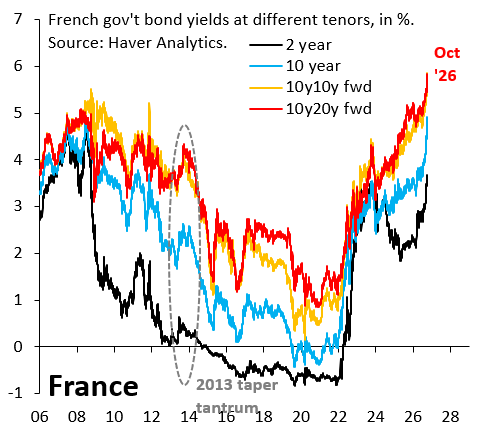
French long-term yields are out of control. The black line in the chart above is the 2-year yield, which captures market expectations for monetary policy. The blue line is the 10-year yield, while the orange and red lines are the 10y10y and 10y20y forward yields, respectively. It’s clear that things have begun to spin out of control. What’s concerning is both the level of long-term yields, which are the highest in over 20 years, and the speed at which they keep rising. In the end, debt markets are about sentiment and that’s turned decisively against France.
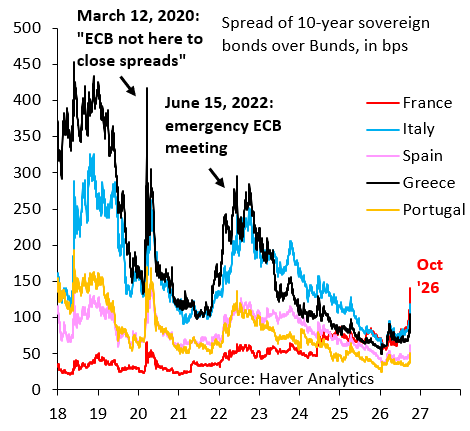
The ECB will obviously come in to cap yields. There can be absolutely no suspense on how this all ends. The ECB will come in to cap yields. It’ll say that widening spreads are interfering with transmission of monetary policy, which is what it did in 2022 when in June it held an emergency meeting, intervened behind the scenes to cap Italian and Spanish yields and introduced a new tool - the TPI - to normalize this intervention going forward. Spreads are still tight by historical standards as the chart above shows, but - at the pace at which they’re widening - it’s a matter of weeks before the ECB will intervene again. None of this will be good. It’ll be yet another instance where a bad precedent is set, one that normalizes stuff the ECB has no business doing.
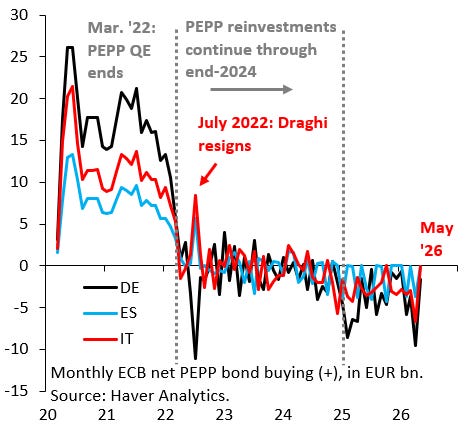
France is the symptom, the ECB is the disease. As the chart above shows, the ECB used proceeds from maturing German government bonds to buy Italian and Spanish debt in 2022. None of this was known at the time. It all happened behind the scenes, with data on this only available with a lag. In the end, politicians in France are just like politicians everywhere else. They respond to incentives. The incentives the ECB has set are that it’ll bail people out when they’re in trouble and that it’ll invent all kinds of word salad - like “financial fragmentation” - to justify this. This all starts and ends with the ECB. Germany and other Northern European countries need to accept the fact that the ECB needs to be prohibited from operating in sovereign debt markets. That’ll cause defaults and will be bumpy. But it’s the only way to guarantee long-term survival of the single currency, which - with the rise of the AfD - is at risk like never before.
The underlying issue at the ECB is that - these days - the representatives from low-debt Europe don’t have the stomach to stand up to the high-debt South. The best way to fix that is to have claw backs that hold people accountable, even after they leave the ECB. An example of this is Isabel Schnabel who just announced her departure for the IMF. She cheered the TPI back in 2022 and - in the short term - crisis was avoided. But the costs of her actions are only felt over the medium term, so it’s important to align accountability with the actions people take. If you push for something like TPI, which is a permanent facility, you should be accountable permanently. You don’t get to ride off into the sunset.
Timely piece but although I agree with the final bailout by ECB it is hard to see this happening with a blank check i.e no reduction of deficit and efforts from France.
I cannot see a French bailout currently with 1) deficit running at 5.5% and no structural reforms like retirement age. Do you think that Germans will allow a 63 retirement age when they are pushing it to 70? Do you think that Spain,Portugal and others will accept a blank check when they had to do some reforms and go through some pain?
2) you also forget that we are in an election year and the two main parties RN and LFI are not known for their Euro friendly views. So would ECB bail them out no it want to keep the pressure so France reform and euro sceptics moderate.
Yes, politicians respond to incentives. That includes incentives from voters. To this point, French voters have been very clear: No new taxes, no cuts! UK and US voters are not far behind in this regard. And therein lies the problem.