
Thank you for subscribing to my posts. If you’re not yet a paying supporter, please consider becoming one. That’ll allow you to DM me with questions and comments. Your contribution will help cover the cost of the data I use in my posts, which I fund out of my own pocket. Thanks so much for your support and feedback!
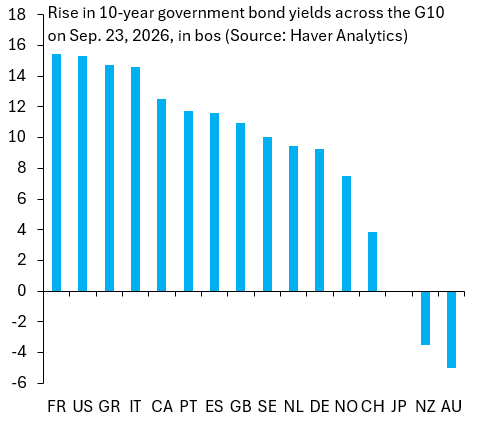
There’s days when markets do very unusual things. Today is one of those days. Long-term government bond yields jumped in quite an alarming way. This got started this morning with stronger-than-expected survey data from S&P Global, which point to stronger activity and a more worrying inflation picture on a global level, but above all for the US. This pushed up market pricing for Fed hikes - there’s now 18 basis points priced for the October meeting and near 100 basis points priced cumulatively through the end of 2027 - and long-term yields rose all over the place, with high-debt France, Greece and Italy hardest hit outside the US. This is a bad time to have lots of debt.
A separate dynamic - which adds to all of this - is the fact that gasoline and diesel prices have been rising wildly. That’s leading to all kinds of speculation, including that we’ll get an export ban in short order and that President Trump cuts a deal with China when he meets President Xi tomorrow. The gist of all this is that China ramps up exports of refined product ahead of the midterms in return for free reign over the Pacific. I’ll do a quick recap on bond markets here and then focus on an export ban, who outside the US gets hit by such a measure, and - most important - whether China is likely to cut a deal in tomorrow morning’s regular post.
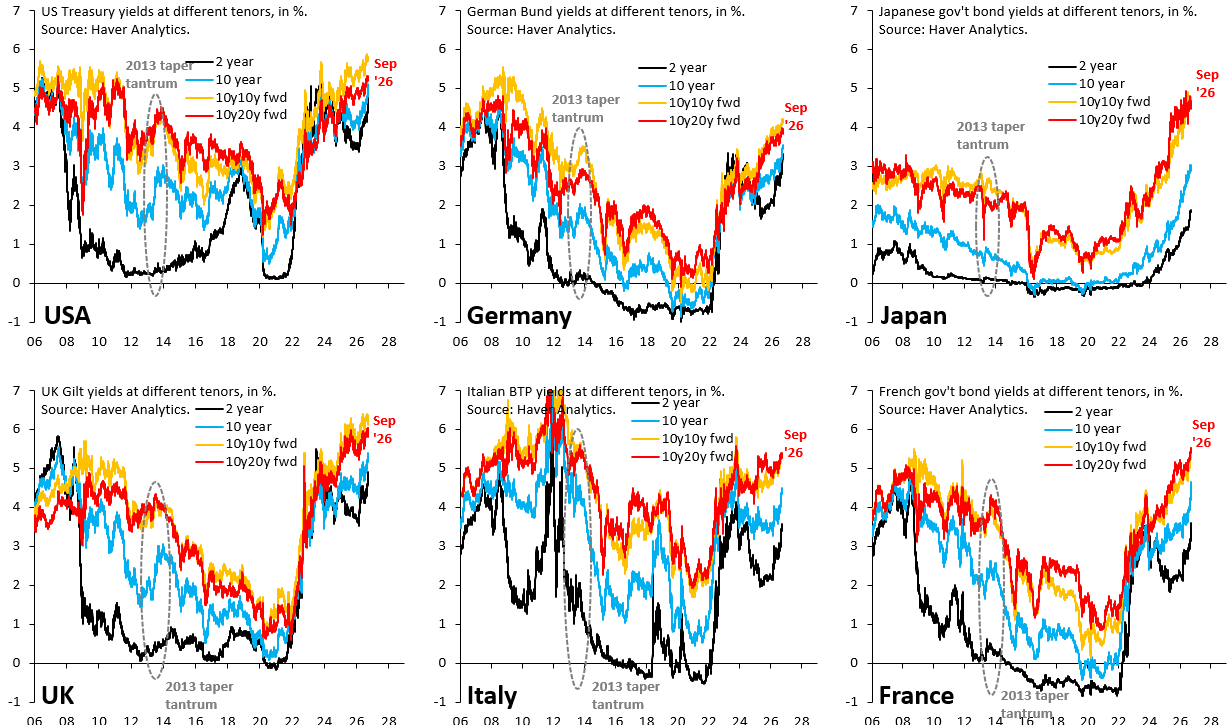
The charts above show yield curves for the US (top left), Germany (top middle), Japan (top right), the UK (bottom left), Italy (bottom middle) and France (bottom right). The black line in every chart is the 2-year government bond yield, which captures markets’ monetary policy expectations. The blue line is the 10-year yield, while the orange and red lines are, respectively, the 10y10y and 10y20y forward yields. The latter two reflect what markets price for the 10-year yield in 10- and 20-years’ time. Key points:
Markets think central banks are behind the curve: today’s wild rise in yields emanated out from the front end of the curve, i.e. the 2-year yield. So this is all about central banks being behind the curve. This pulled up everything out to the 10-year yield, while 10y10y and 10y20y yields were pretty stable, so - on the whole - today wasn’t about out-of-control fiscal policy. It was about growth and inflation.
High-debt countries are extremely vulnerable: the exception to the pattern I describe above - whereby longer-term yields stayed anchored - doesn’t hold for high-debt places like France, Italy and Greece. I’ve talked a lot in recent posts about how markets are penalizing high-debt countries. That’s definitely true today. The chart below shows the rise in 10-year yields across the G10. France is up more than the US, even though it’s from the latter that data were strong.
The distinction between growth and fiscal is academic: there’s a big debate on whether rising long-term yields are about growth or fiscal distress. Today’s a reminder this distinction is of interest to nerds only. What happened today is that we got strong data for the US and then fiscally vulnerable places caught on fire. Getting hung up on that distinction misses the forest for the trees.
In the background to all this is a mounting fear that President Trump might do something radical - like an export ban on diesel or make a crazy deal with China - as the midterms draw near. I’ll talk about all that in tomorrow morning’s regular post.
One thing that can be counted on is that trump will make a bad situation worse. That goes for China, diesel, the economy and America's standing in the world.
Robin's been saying for months that we're in a debt crisis and now it looks that way.