
Thank you for subscribing to my posts. If you’re not yet a paying supporter, please consider becoming one. That’ll allow you to DM me with questions and comments. Your contribution will help cover the cost of the data I use in my posts, which I fund out of my own pocket. Thanks so much for your support and feedback!
There’s no science that tells us when markets pull the plug on reckless fiscal policy. One moment they’re happy to buy all the debt issuance - at low interest rates - that comes with big budget deficits. The next they want higher yields because they worry things are heading for a debt crisis. This sentiment shift can spark a negative spiral because rising yields over time will push up the government’s cost of servicing its debt, i.e. it can push a country’s public finances from a good to a bad equilibrium.
There’s multiple equilibria when it comes to debt and it’s one of my big convictions that - in the years since the COVID pandemic - we’ve begun to shift from a good to a bad equilibrium. This is in my opinion why seemingly innocuous things like Powell’s dovish keynote speech at Jackson Hole a year ago sparked the absolutely insane rally in precious metals prices we saw last year. That “debasement trade” in my mind is all about markets seeing the writing on the wall when it comes to fiscal policy. This also helps explain why there’s now so much hand-wringing about Fed credibility. Gold is up almost ten percent since the last Fed meeting on July 29. Markets are increasingly worried the Fed is subject to fiscal capture and that’s something that predates Warsh.
There’s also the fact that the number of fiscal “accidents” is growing. I’ve written a lot about Japan, where the Bank of Japan buys government bonds on an open-ended basis to cap yields. This prevents a full-blown debt crisis, but means that yields don’t price the kind of risk premium markets want, which puts depreciation pressure on the Yen. The weak Yen is therefore a symptom of Japan running out of fiscal space. The same is true for the UK, which had a major bond market blow-up in the fall of 2022, and for Italy and Spain, which had similar blow-ups over the summer of the same year.
In today’s post, I look at why things are coming to a head. In my opinion, there’s three reasons: (i) during COVID, countries all around the world ran huge deficits and we’re only seeing now - with a lag - the adverse consequences of this global debt binge; (ii) since the pandemic, fiscal policy has come untethered, with many countries running deficits that are unusually wide for a non-crisis period; (iii) global geopolitical risk is elevated, which means spending needs on defense are higher than we thought they’d be a decade ago.
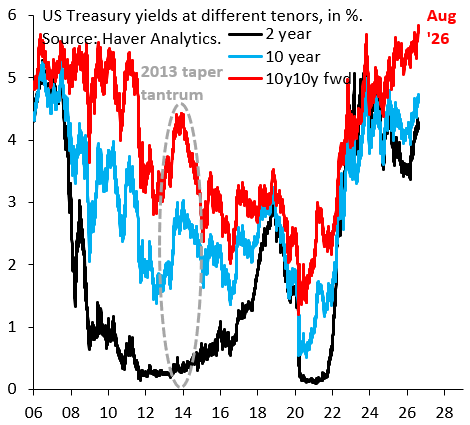
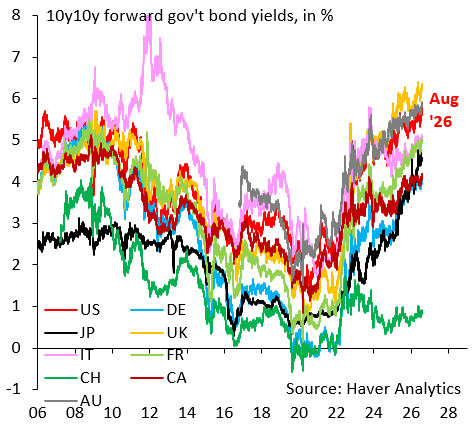
The global COVID debt binge: The red line in the chart above shows the 10y10y forward yield for the US, which I back out from 20- and 10-year Treasury yields. This yield in the past week rose to its highest level in 20 years, which is worrying. What’s even more worrying is that this is happening on a global scale. The chart below shows 10y10y forward yields across key G10 economies. The US doesn’t even stand out in this perspective. Rising longer-term yields are a global theme and stem from the global debt binge that happened during the pandemic.
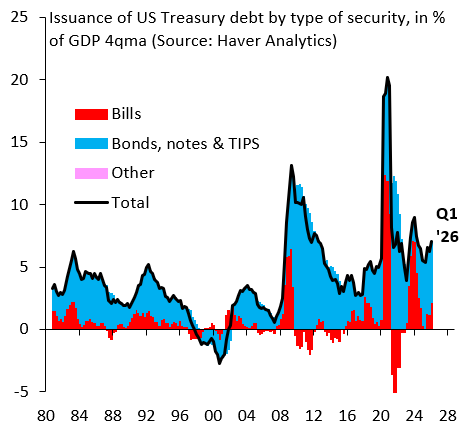
Fiscal policy has become unmoored: the chart below shows how the US budget deficit has been trending steadily higher for the past decade. In the year through Q1 2026, US debt issuance amounted to a stunning seven percent of GDP. This at a time when the economy was relatively healthy and there was no big shock like COVID. There’s obviously a case for deficit spending, but that needs to come with an understanding that those deficits get reigned in once shocks subside. That no longer happens. The unmooring of fiscal policy holds across Republican and Democrat administrations. It’s also evident more broadly on a global scale.
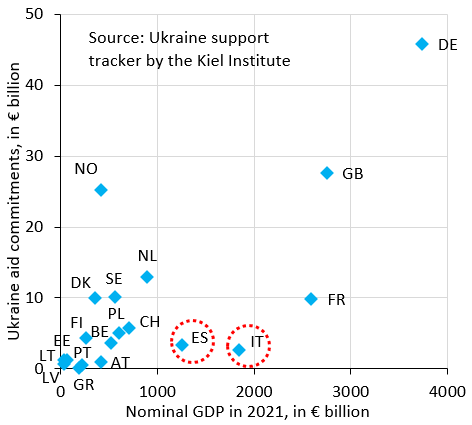
Unstable global geopolitics: shocks like Russia’s invasion of Ukraine strain public finances everywhere, but are putting a disproportionate burden on what were up until now low-debt countries. The chart below shows nominal GDP on the horizontal axis and aid to Ukraine (financial, humanitarian and military) on the vertical. Germany is picking up the tab for Italy and Spain that have run out of fiscal space. This is why German debt is no longer trading like a safe haven asset. What previously were global debt safe havens are falling by the wayside. There’s fewer places to hide in global bond markets, which pushes up yields still further.
These three things are now combining to inexorably push longer-term government bond yields up all around the world. That’s why the debasement trade has a lot further to run in my opinion. Pressure on central banks to cap yields will only grow, that will increase worries about fiscal capture of monetary policy, so safe havens like gold and currencies like the Swiss Franc and Swedish Krona will keep getting bid up.
What strikes me isn’t a case of “unfalsifiable, therefore true” — rather, the thesis performs the very phenomenon it describes. You argue markets shift equilibria on sentiment rather than any scientific threshold; the trouble is, whether that argument itself holds up can only be judged after the fact — which is to say, it too comes down to sentiment dressed up as science. Not a contradiction so much as a rather elegant bit of self-reference. The market, judging itself, using the market’s own methods.
Useful food for thought for the FX book. Much obliged for the sharp read.
That’s gloomy.