
The US has announced a naval blockade of Iran, something I’ve been advocating for almost a month. An embargo of Iranian oil, which is what a blockade is, has pros and cons as I discussed in a recent post, but - at this point - the pros materially outweigh the cons. There’s two reasons why I think this. First, Iran is a relatively small supplier of oil to global markets, which means that - taking it offline - shouldn’t push the front-month futures contract for Brent much above $120, which is well-trodden territory at this point that global markets can handle. Second, much like Russia, Iran runs on the cash generated by its oil exports. Leaning on this money machine sends the economy into a tailspin, giving the mullahs much needed motivation to negotiate in earnest.
The main uncertainty is that the mullahs may not be fussed by the suffering of their own people as Iran’s economy implodes. There’s no fixed number of weeks in which a blockade can be expected to bring the mullahs to the negotiating table. But what I do know is this: as Iran’s oil exports collapse, there’ll be no cash for imports, so activity implodes, the currency goes into a devaluation spiral and hyperinflation ensues. Had we done this for Russia after its invasion of Ukraine, I’m pretty confident we wouldn’t still be watching that war grind on. Russia and Iran are gas stations masquerading as countries. The best way to hit them is to shut down their gas stations.
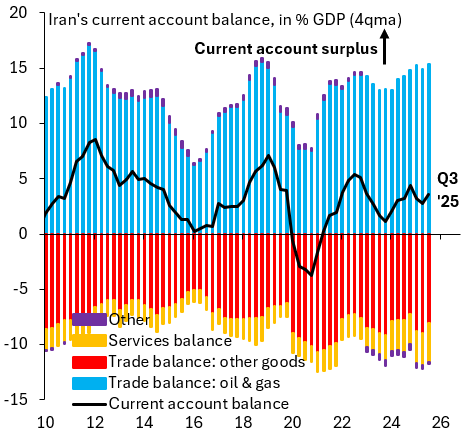
The chart above shows the underlying drivers of Iran’s current account surplus (black line). Oil exports (blue) pay for imports of goods (red) and services (orange), so - if you interrupt oil exports - you force the red and orange bars to zero. That’ll cause severe shortages in Iran, causing economic activity to tumble. The absence of hard currency inflows also means the currency will enter a devaluation spiral, pushing inflation up sharply. The consequences of a blockade for Iran’s economy are therefore dire. There’s no doubt in my mind this’ll bring the mullahs to the negotiating table in good faith.
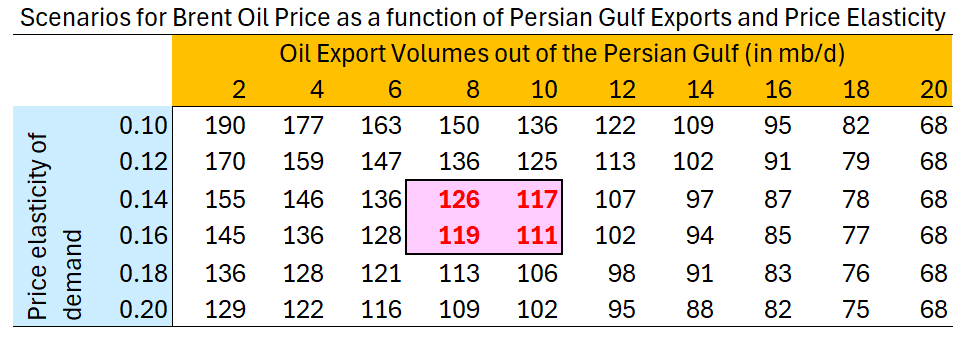
The big question is how much taking Iran’s oil off global markets spikes oil prices. In my opinion, that’s a manageable risk. The table above shows my calculations for what various scenarios of oil out of the Persian Gulf imply for oil prices assuming different price elasticities of demand. My base case is an elasticity of 0.15 and the Persian Gulf operating at half its pre-war capacity (10 mb/d). That puts Brent at $114. Taking Iran’s oil off the market implies a further 2 mb/d supply cut, taking Brent to $123. Numbers like these are well-trodden ground for global markets at this point, which in my view favors doing a blockade. The goal is to end this war more quickly by bringing the mullahs to the negotiating table in good faith.
Robin. You seem to be professional and coherent so I’m trying to give your argument some real consideration. What I don’t understand is: 1) The U.S. blockade will be blocking ships legally transiting international waters after they’ve cleared the SOH. That’s piracy. Should the U.S. just give up on following international law - perhaps since we’ve already violated it so much? Just become pirates and accept our supervillain role? 2) You say the pain of the blockade will bring the mullahs to the table. I believe the mullahs were already at the table, 60 people strong, in Islamabad, while we sent a small inexperienced team who had no power to negotiate. And we put a number of untenable ultimatums on the table. To much of the globe it appears the mullahs did show up to talk (as they were doing in Geneva before all this started) and it’s the U.S. side that’s confused, incoherent and demanding rather than negotiating. 3) Comparing this to Russia-Ukraine is disingenuous. While you’re likely correct that we should have taken stronger action against Putin’s oil in 2022, if we had that would have been a strong move by a large group of allied countries against an aggressor who invaded their neighbor. In this case, we’re the invaders. With no allies. Robin - I appreciate your formidable economic expertise, but feel like I’m looking at a tiny slice of the picture with little consideration of the diplomatic, legal, and larger strategic implications.
As all military analysts I listended to, I do not believe that the embargo of Iranian oil could work. The Iranians will see this as economic warfare and are most likely to retaliate with drones or missiles on other vessels with whatever cargo, or on the Arab side of the Gulf. They only need a few to hit a target. This would put a hold on everything wanting to leave the Gulf through the Strait. Furthermore, if buyers of Iranian oil would assume ownership of it FOB, as used to be very traditional practice, then the oil would be, for example, Chinese-owned oil in a tanker under Chinese or whatever flag. Would the US-navy block such a tanker with military force ???