
Thank you for subscribing to my posts. If you’re not yet a paying supporter, please consider becoming one. That’ll allow you to DM me with questions and comments. Your contribution will help cover the cost of the data I use in my posts, which I fund out of my own pocket. Thanks so much for your support and feedback!
A debt crisis ends one of two ways. Either a country makes needed adjustments and wins back the confidence of investors or it loses market access, in which case there’s a debt write-down that bails in the population via losses in the banking system and in people’s retirement accounts. One way or another, the cost of unsustainable policies is borne by the domestic population, which is as it should be. It’s preferable that be done via orderly policy changes like tax hikes or spending cuts, but a debt write-down gets you to the same place if there’s no political consensus for fiscal adjustment.
In the Euro zone, there’s a third option, which is for countries to grab German fiscal space to defray market pressure on their public finances. This is what’s happened over the past decade. When Draghi in 2012 said the ECB’ll do “whatever it takes” to preserve the Euro, it would have been more transparent to say: “we’re going to appropriate a ton of German fiscal space to avoid sovereign defaults in Italy and Spain.”
There was never a need to tie avoidance of sovereign defaults to survival of the Euro. Indeed, it’d be better if sovereign defaults were the norm inside the Euro instead of being artificially suppressed, as I said yesterday. But - as long as Germany allows itself to be cowed by high-debt countries and their threat of Euro breakup - others will keep appropriating its fiscal space. I therefore have no doubt the ECB will intervene to cap yields in coming weeks. The grab for Germany’s fiscal space obviously isn’t politically sustainable, which is why it’s hidden and camouflaged. But the rise of the AfD will shine a light on all this and bring needed change.
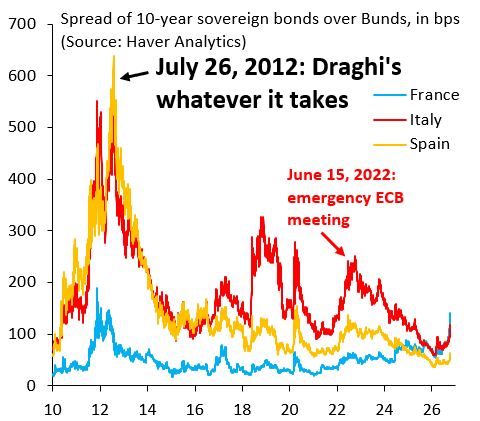
The chart above shows the spread on 10-year government bond yields for France (blue), Italy (red) and Spain (orange) over Germany. Here’s the thing. Spreads for Italy and Spain are far below where they were at the peak of the sovereign debt crisis in 2011 and 2012, which makes it seem like these countries got their acts together. They didn’t. The chart below shows public debt in percent of GDP from 2000 to 2025. Debt for Italy and Spain is above where it was in 2010, so they didn’t reform their way out of fiscal crisis. They just coerced the ECB into using German fiscal space and Germany’s leaders - Merkel, Scholz and now Merz - are too meek to stand up to this or - at the very least - demand meaningful reforms so this doesn’t go on indefinitely.
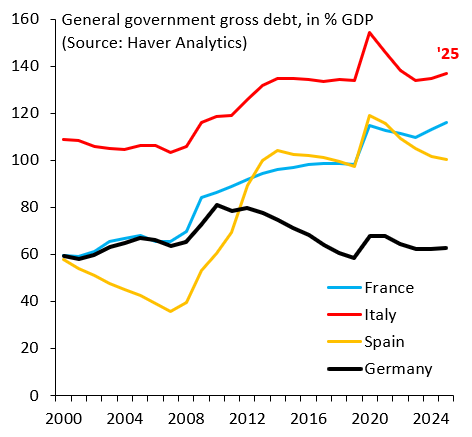
The truth is that the Euro zone sovereign debt crisis never really ended. It just got papered over by an ECB that’s using German fiscal space to paper over the fact that many Euro zone countries are basically broke. As I argued last year, this approach is doomed to fail. That’s because Europe doesn’t just need to avoid fiscal blowups. It needs to be able to spend money, i.e. it needs fiscal space. The mere avoidance of debt crises doesn’t accomplish that. It just means Europe limps along while resentment builds in Germany. The Euro - in its current form - can’t and won’t survive.
Great analysis and article... and some slight nuance here: back in 2012 and Draghi's 'whatever it takes', the German "Landesbanken" and other regional banks and even pension funds had filled their boots with PIGS bonds (Portugal, Spain, Italy, Greece). Any default by the PIGS would have brought down the entire german banking system... - so it's not some naivite or altruism on the German part, they simply had no choice. My guess is that today the German banking system is less exposed, and as a consequence Germany may not allow the ECB to be so trigger-happy...
I’m sure I’ll catch a lot of flack for saying this, but the US debt was under $1 trillion dollars before “trickle down economics” was introduced by the Reagan administration. Coincidence? I think not! It’s been a colossal failure, yet it just won’t go away.