Turkey blows itself up - again
The paths will vary, but the final destination for Erdogan's Turkey is always devaluation

Thank you for subscribing to my posts. If you’re not yet a paying subscriber, please consider becoming one. That’ll allow you to DM me with questions and comments. I plan to move my posts behind a paywall in coming months. Subscribing now locks you in at a low rate. Thank you so much for your support and feedback!
British soccer legend Gary Lineker coined the phrase: “Football is a simple game; twenty-two men chase a ball for 90 minutes and - in the end - the Germans always win.” Turkey feels similar. You never know how they’re going to do it or when exactly it’ll happen, but in the end the country always manages to blow itself up.
What’s in the press is that a Turkish court yesterday removed the leader of the main opposition party - Erdogan’s latest move to consolidate power - and markets went into a tailspin. That’s the tip of the iceberg. The underlying dynamics are always the same. Turkey is deeply divided politically, so Erdogan ceaselessly pushes growth as much as possible to stay in power. The result is an ever-widening current account deficit as high growth sucks in imports. There’s always some catalyst or other that then blows things up. Now it’s the court ruling. In 2025, it was the arrest of Ekrem İmamoğlu, Erdogan’s main political rival. The list goes on, but these incidents - as tragic as they are - are merely catalysts. The underlying issue is that growth is running far above its natural speed limit, so Turkey blows up when any old shock comes along.
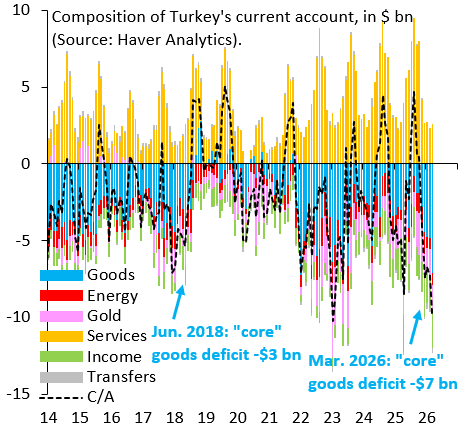
The chart above shows the composition of Turkey’s current account deficit (black dotted line). The key thing I do here is to take energy (red bars) and gold (pink bars) out of the trade balance, which leaves what I think of as the “core” goods deficit (blue bars). I can remember watching this deficit in early 2018 and worrying it was far too wide. Sure enough, the Lira devalued sharply in August of that year when President Trump - then in his first term - hit Turkey with sanctions (yet another catalyst). At the time, the core deficit was around -$3 bn. The latest reading for March 2026 - the first full month of war with Iran - is a staggering -$7 bn. Recall that this number excludes energy imports and gold, so this deficit is about the growth-at-all-costs policy mix. It has little to do with unfavorable developments abroad.
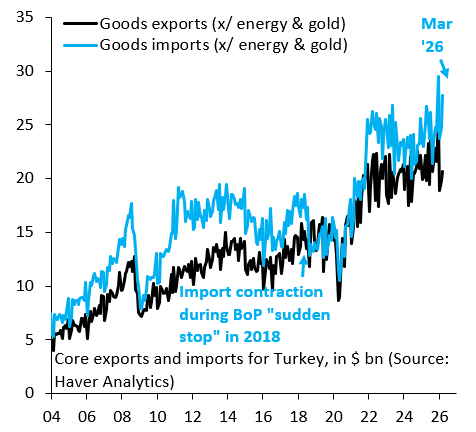
How could the core goods deficit get so bad? The blue line in the chart above shows core imports, i.e. excluding energy and gold. The black line is the same for exports. Imports are near historical highs, but what’s pushed the deficit to record levels is the fact that exports weakened in the course of 2026, an unavoidable side-effect of the war with Iran. Turkey’s massive import bill leaves it vulnerable to this kind of disruption. That’s not about oil prices, but something much bigger. If global growth falters, Turkey’s exports fall and there’s no cash to pay for its huge import bill.
Turkey’s central bank has been straining to avoid devaluation since the war with Iran began. This has meant record sales of official FX reserves, which were mobilized by selling and swapping gold holdings. There’s little ammunition left to fend off this latest shock as a result. The final destination for Turkey is always devaluation.
Turkey -- trades like chicken.
Erdogan has many failings but an Islamist terrorist he is not. Perhaps you could produce some evidence for your assertion? Ian