
Currencies go up and down. The reasons why they do this are often unfathomable, even with the benefit of hindsight. The recent fall in the Dollar is especially vexing. Models tell us that tariffs should have led to an appreciation of the Dollar, because they’re a negative shock on the countries being tariffed. The fact that the Dollar has fallen is therefore quite odd and worrying.
In yesterday’s post, I dismissed recent chatter that the US is having a “Liz Truss” moment. There’s little doubt that US fiscal policy is on an unsustainable path, but dysfunction in the Treasury market is nowhere near what the UK experienced in its bond market blow-up in September and October 2022. In today’s post, I go through the key features of the recent Dollar decline and discuss potential drivers.
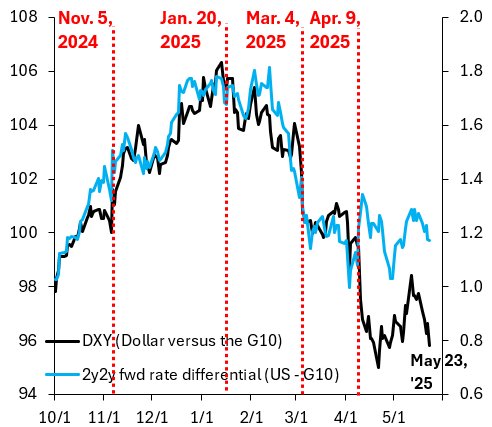
First of all, Dollar weakness isn’t quite as bad as it at first looks. As I noted in my first post, there’s four discrete moves in the Dollar since November 5: (i) a six percent rise that began right after the election and ran through inauguration day on January 20; (ii) a two percent fall in early February, sparked by on-again, off-again tariffs on Canada and Mexico; (iii) a four percent fall in early March due to Germany’s surprise fiscal stimulus; and (iv) another four percent fall that came on April 9 with announcement of the 90-day pause in reciprocal tariffs that were announced just a week earlier. The chart shows these turning points for the Dollar (black line). It also shows the 2y2y forward rate differential (blue line), which many people track as one of the key determinants of Dollar moves.
The fall in the Dollar from its post-election peak is therefore 10 percent, but four percentage points in that decline have nothing to do with Dollar weakness. They’re about Euro strength after Germany’s surprise fiscal stimulus. When you adjust for that, the Dollar is flat since November 5: it rose six percent through January 20, whereafter it fell six percent on US tariff announcements in February and April.
The fact that the Dollar fell around tariff announcements in February and April is telling. It suggests markets dislike the chaos of those announcements: the initial imposition of tariffs, followed in short order by a pause. The decline in the US rate differential vis-à-vis the rest of the G10 around these dates suggest markets see this chaos as a negative for US growth, with this negative growth impulse so big that it forces the Fed to cut rates even in the face of whatever inflation tariffs may bring.
The underlying question is whether Dollar weakness is temporary - a cyclical rerating as markets ditch US “exceptionalism” - or whether it’s the start of a terminal decline. As I note in a previous post, US reserve currency status took many decades to build and has been stable through many past ups and downs in US policy making. Whatever is going on with US policy now, it’s thus unlikely to erode reserve currency status - even a little bit - any time soon. That leaves a cyclical rerating as the most likely explanation for recent Dollar weakness and - in my mind at least - means that recent Dollar declines are just part of the usual up and down in global currency markets.
Your last statement about where it all depends seems to me exactly correct. The statement that the two latest movements are a reaction to the tariffs is somewhat similar perhaps to the many economists who said that inflations were only caused by oil prices. Oil prices adjustments are symptomatic of inflation, and tariff swings are symptomatic of erratic governance, which seems to me to underlie most of these economic problems.
I continue to read your analysis and hope you don’t mind comments. I think we are in a Lettuce Truss situation, but this is one very big and powerful head of lettuce which took 70+ years to bring forward. It will take a long time to go bad.
The dollar followed a very similar path in 2016-17. Appreciating eading up to Trumps 1st inaguration and then reversing back down to eventaully 89 dxy in 2018. The economy was quite robust during this time.