
In my preview for 2026, one of my central predictions was that emerging markets (EM) would attract record foreign investor inflows into stocks and bonds this year. I think there’s two reasons for this. First, we’ve entered a phase of sustained Dollar weakness, with the Dollar falling especially consistently against EM. Second, there’s an erosion of institutional quality across advanced economies, which makes them - in the minds of many investors - more EM-like. That equates to a structural upgrade for EM that should see portfolio allocations rise after many years in which they were cut back.
Even if EM does well overall, the tide doesn’t always lift all boats equally. In today’s post, I look at which EMs look like they’re benefitting disproportionately. Most EMs only have quarterly data on foreign inflows from the Balance of Payments (BoP) and in most cases these data end in Q3 2025. That makes it almost impossible to give an up-to-date assessment for what’s going on. I pick out seven EMs that have monthly BoP data and look at how foreign inflows are evolving. To make these flows comparable across countries, I scale each country’s non-resident portfolio inflows by the standard deviation of these flows between Jan. 2000 and Dec. 2019. This scaling flags where inflows are abnormally large in a statistical sense.
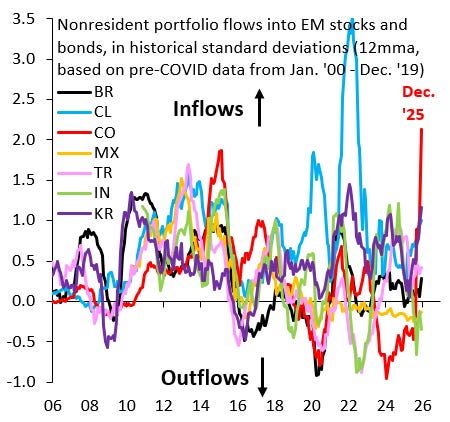
The chart above shows these non-resident inflows for the seven EMs I’m looking at here. There’s an obvious common factor across all countries, with outflows during the global financial crisis, inflows from 2010 during the Fed’s succession of QE programs and then outflows during the COVID shock. Colombia (red), Chile (blue) and South Korea (purple) saw especially strong inflows towards the end of last year, so this is probably where momentum is strongest in the early stages of this year.
The subset of seven countries with monthly BoP data is obviously a bit random. I’ll broaden this perspective out to a much bigger set of countries in coming days. The big picture - from quarterly BoP data that I’ve written up in recent posts - is that non-resident portfolio flows into China have been very weak in recent years, even as flows to the rest of EM have been unusually strong. The world has been decoupling from China in terms of capital flows, a shift that began after Russia’s invasion of Ukraine.
Brazil looking rather modest given our level of carry. I'm surprised.