
Thank you for subscribing to my posts. If you’re not yet a paying supporter, please consider becoming one. That’ll allow you to DM me with questions and comments. Your contribution will help cover the cost of the data I use in my posts, which I fund out of my own pocket. Thanks so much for your support and feedback!
Germany is struggling with three distinct challenges at the moment. First, its growth model is broken. It’s tempting to say that’s about the loss of cheap Russian energy, but it’s more complicated than that. The stagnation of German industry predates Russia’s invasion of Ukraine and everything that followed. Something bigger is afoot. Second, every time a bad shock hits, Germany has to face down all the high-debt countries in the Euro zone. Either Germany shoulders the bulk of the financial burden outright, as is true with Ukraine, or it subsidizes high-debt countries indirectly, as with joint debt issuance during COVID. The Euro perpetuates this equilibrium where Germany pays and of course this isn’t politically sustainable, especially now that the growth model is broken. Third, the political center in Germany is breaking. That’s the lesson from the slew of regional elections recently, where either the AfD or the successor party to the East German communists won. The political center is paralyzed and as a result more and more Germans are turning to the extremes, including in former West Germany.
I did a live stream on all this yesterday just ahead of the state election results from Mecklenburg-Vorpommern and Berlin. Today’s post is a follow-up that elaborates on these three points.
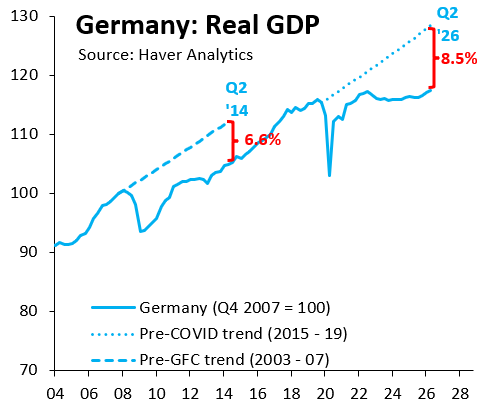
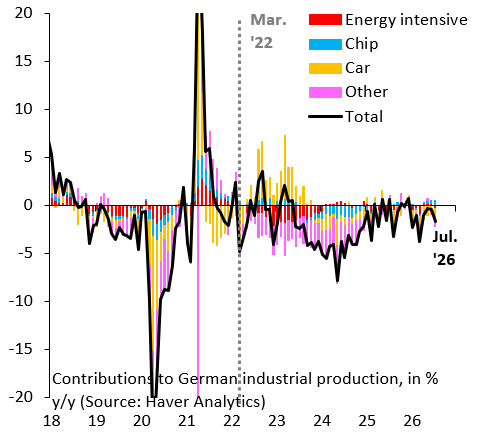
Broken growth model: the chart above shows Germany’s real GDP where I compare its level to its pre-2008 and pre-COVID trends. This is an exercise in what could have been and highlights that Germany’s output gap - the difference between where GDP should be versus where it actually is - is bigger now than it was after the global financial crisis. As the chart below shows, this isn’t just about the loss of cheap Russian gas. Energy intensive industries (red bars) did suffer in the aftermath of 2022, but the ongoing stagnation in industrial production (black line) is far broader and pre-dates Russia’s invasion of Ukraine. This is about the VW diesel scandal, being late to electric vehicles and too much red tape. Germany has been the sick man of Europe before. The Chancellor at the time - Gerhard Schröder - undertook deep labor market reforms, restoring competitiveness. That’s unthinkable in the current grand coalition, which is paralyzed on all fronts, including needed economic reforms.
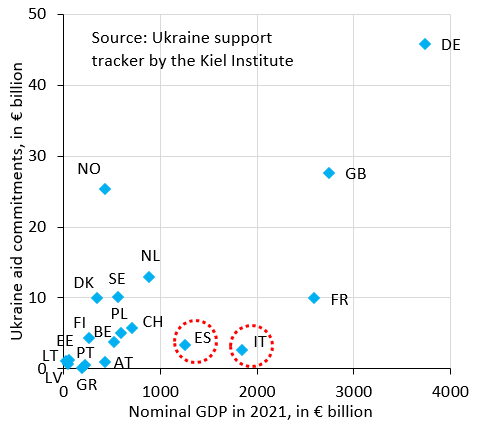
The stand-off with high-debt countries in the Euro: I’ve written extensively on this and also did a recent live stream, so I’ll be short here. The chart below shows aid countries give to Ukraine on the vertical axis versus their economic size on the horizontal. I’ll only note here that the AfD has recently begun re-emphasizing Euro exit as one of its goals. Euro exit has always been in the background, but it’s played second fiddle to immigration for many years. The fact that the AfD is now elevating this issue means it smells this is a vote getter. The fact that Germany subsidizes high-debt countries is objectively wrong and the AfD is picking up on this as a salient issue. I’d much prefer the current government to defend German interests more effectively within the Euro, but it’s showing itself to be completely unwilling to do so, most obviously with its support of people like Joachim Nagel at the Bundesbank and Isabel Schnabel at the ECB. These are Germans who have a track record of doing the bidding of high-debt countries.
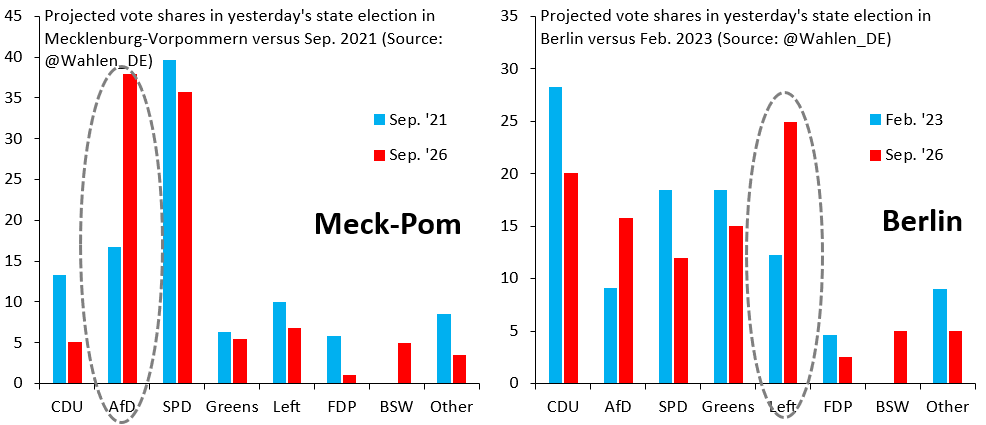
The political center breaks: there’s two conclusions from yesterday’s elections. First, German post-war politics has always been about moderation. That’s over. In Mecklenburg-Vorpommern, the AfD notched up its second major win (left chart below). In Berlin, the successor party to the East German communist party got the most votes (right chart below) and in several respects they’re even more extreme than the AfD. Second, immigration is an issue that Germans are deeply unhappy about. That’s propelling the AfD higher everywhere, including in former West Germany. The grand coalition’s paralysis on this is especially concerning.
Grand coalitions have a terrible track record in Germany. They result in paralysis and drive the electorate to the extremes. Unfortunately, Germany is headed for a political and economic apocalypse and - being so big - it’ll drag the rest of Europe with it.
As I live in Germany I can only agree to all your arguments. Thank-you for your objective analysis. All true. I also want to highlight that the coalition system leads to stagnation by design, as the center parties always end up putting their votes together to attain a governing majority and leave the same people in power. What was originally designed to give stability has lead to extreme stagnation. What is new and interesting is the permanent and aggressive framing of the AfD as "extreme" far-right. Any party attracting around 38 % of voters can barely be qualified as "extreme". If anything those votes are an outright cry for change.
For many years, Germany benefited from the Euro being weaker than a Germany-only currency. Not sure that is at an end.
Immigration is unpopular but ending immigration will end whatever growth is left in the German economy. The native population is declining. Many of the immigrants are highly skilled and even those who aren’t often are over-qualified for their employment in Germany. If the AfD wins, Germany will just fail quicker.
No one wants to hear that employment laws directed at the age of mass-manufacturing must change. No one wants to hear that young people need to get in the workforce quicker. No one wants to hear that society needs to change from risk-averse to risk-embracing.
The future is not bright- especially when people are upset about the wrong things.