
Thank you for subscribing to my posts. If you’re not yet a paying supporter, please consider becoming one. That’ll allow you to DM me with questions and comments. Your contribution will help cover the cost of the data I use in my posts, which I fund out of my own pocket. Thanks so much for your support and feedback!
Back in December, I wrote a post called “The Political Apocalypse in Germany.” The post is about the rise of the AfD, which I think is the single biggest shock facing Europe at the moment. After all, will a Germany with AfD in power defend the Baltics or Poland should Russia attack? Given its pro-Russia leanings, that’s not clear. Will the AfD pull Germany out of the Euro once in power? The AfD got its start as an anti-Euro party in 2013, so that’s also on the menu. There is, in short, nothing more systemic or urgent in Europe right now.
It’s tempting to dismiss yesterday’s massive win of the AfD in Sachsen-Anhalt, which is Germany’s poorest state and has a population of only two million (out of Germany’s 84 million). That’d be a mistake. What’s powering the rise of the AfD is growing alarm that Germany’s political establishment is unwilling to push through needed change on immigration. That’s a broad-based sentiment and not unique to Sachsen-Anhalt.
In this post, I’ll talk about: (i) how the AfD will likely govern even though it missed the absolute majority, so this is the first time Germany gets an AfD-led state; (ii) how what happened yesterday profoundly damages Chancellor Merz, so political instability will rise; and (iii) how this takes us one step closer towards the end of the Euro, which is something I’ve been warning about in posts and a recent live stream.
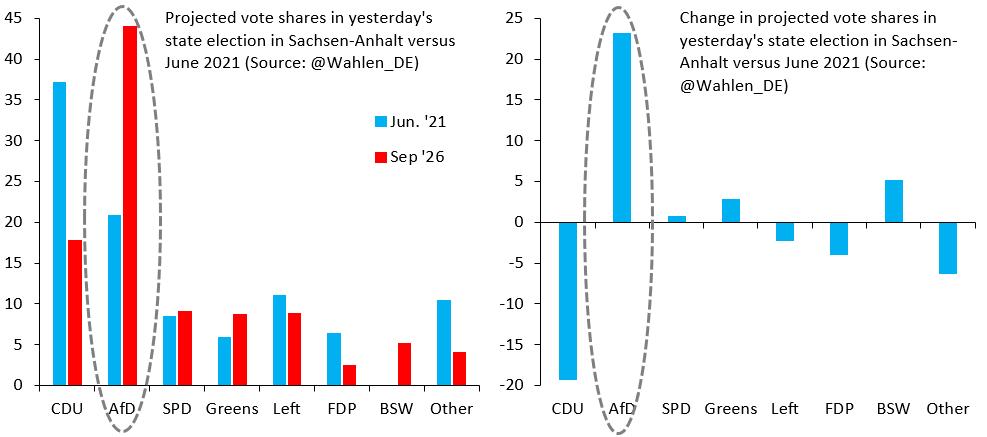
The left chart above contrasts yesterday’s projected outcome in Sachsen-Anhalt (red) with that in June 2021 (blue), which is when the last state election was held. It’s pretty clear that the rise in AfD support is massive and - as the right chart shows - has come primarily at the expense of the CDU. The AfD will just miss the absolute majority, but it’s still likely to govern because - after two procedural votes in the state parliament - a third vote only requires a majority of votes cast to govern, which the AfD is likely to get. So Germany is heading for its first AfD-led state government, which is huge.
There’s two further state elections on September 20, which - depending on how badly they go for the CDU - could spell the end for Chancellor Merz. If he does get the boot, that won’t change anything for the better. In my view, what’s driving the rise in AfD support is a population that wants far more aggressive deportation of migrants. That’s not something the political center in Germany is willing to do, so things will get worse before they get better. This is just the first of many AfD wins.
As far as the Euro goes, I think Germany is on the same path as the US. In the decades after World War II, the US was an altruistic super power, promoting growth elsewhere over its own. “Make America Great Again” is a repudiation of that and puts the US first, after political support for US altruism faded. The rise of the AfD in Germany is a close parallel. Germany has been an altruistic super power within the Euro zone, an era that is coming to an end. This will spell the end of the Euro. The only choice that exists is whether this happens as an amicable divorce or a chaotic one. An amicable divorce would be better and would need to happen before the AfD governs all of Germany.
I think this comment I saw on X best sums it up
it really does break my balls that mainstream political parties don't want to address the elephant in the room (for more than 10 years now) and as a result people start voting for the only parties promising to address said elephant, but which are completely retarded in every other way
Hello Robin,
I strongly disagree with your assumption that Germany has been a major benefactor of the eurozone. In fact, it has been a major beneficiary. It has been running a substantial current account surplus for a long time. Participation in the euro has helped the German manufacturing sector immensely. The mismanagement of fiscal policy within the EZ is another matter, albeit a crucial one.