
Thank you for subscribing to my posts. If you’re not yet a paying supporter, please consider becoming one. That’ll allow you to DM me with questions and comments. Your contribution will help cover the cost of the data I use in my posts, which I fund out of my own pocket. Thanks so much for your support and feedback!
Japan once again intervened to prop up the Yen this week. We don’t have official data yet, so we can’t be certain of its size, but it’s a good bet this intervention was massive and may have surpassed an already huge intervention back in April. The US joined in on this effort, which is a new twist. On the surface, that may give the impression that this intervention will be more impactful than past efforts, but US participation raises more questions than answers, especially the very odd news that the US sold Euros to buy Yen. This kind of twist in my opinion undercuts the efficacy of US participation, because it invariably will have markets wondering why the US didn’t just fund Yen buying out of Dollars. FX intervention is a confidence game. The last thing you want is to give markets any kind of reason to ask questions.
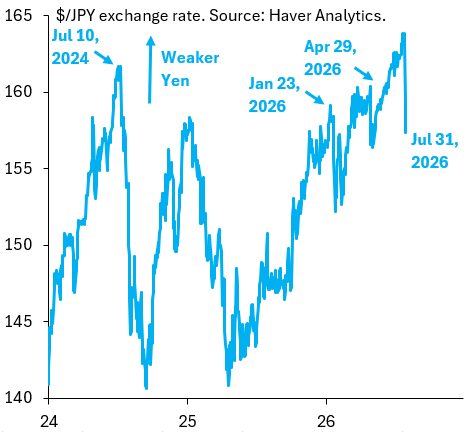
The chart above shows daily data for the $/JPY exchange rate from Jan. ‘24. There’s been two previous rounds of intervention this year alone: (i) the infamous “rate check” by the NY Fed on Jan. 23 ahead of Japan’s Feb. 8 election, a gift to Prime Minister Takaichi who was struggling with a sharply falling Yen after she said she wants to break with “excessive austerity;” and (ii) a huge intervention on Apr. 29 that swamped anything seen previously. Neither of these efforts worked in the sense that the Yen quickly resumed its weakening trend. If anything, the half-life of intervention looks like its falling fast, with $/JPY bouncing back more quickly after the second episode than the first. The Yen will resume its fall after this latest episode. Depreciation pressure emanates from government bond yields that are artificially low. That’s something intervention can’t possibly fix, which is a point I return to below.
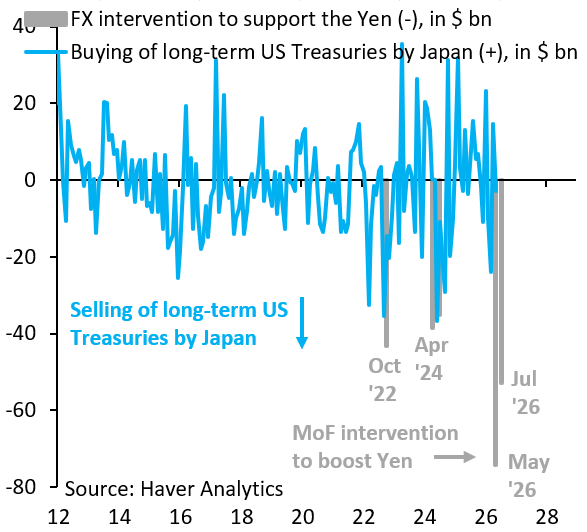
News that the US participated in this intervention - but sold Euros to buy Yen - is confusing markets and will prove counterproductive. As I laid out in a recent note, Japan sells US Treasuries when it intervenes to prop up the Yen, which can be a force for US yields to go higher. Inevitably, markets will now be asking if the EUR/JPY twist reflects US concern that Japan’s interventions are pushing US yields higher. If there’s something to this, markets will see this as a sign of weakness, which will further undercut the already embattled efficacy of Yen intervention.
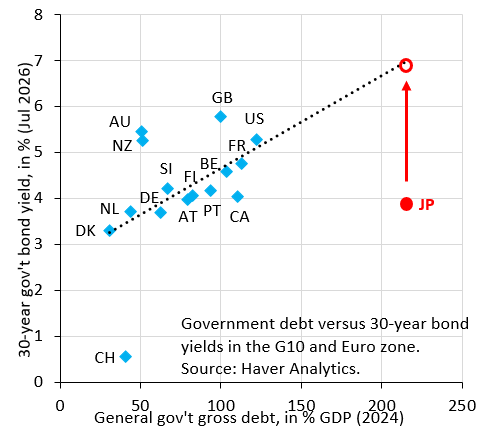
The last thing I’ll say is that I disagree with Treasury Secretary Bessent’s view that the Yen is undervalued. As I have argued in my recent posts on shadow yields, as long as central banks intervene to artificially cap government bond yields, this transfers fiscal stress from the bond market to the currency. The Yen isn’t overshooting. It’s falling because Japan’s high public debt prevents the country from allowing yields to rise freely. The chart above shows my estimate for where the 30-year yield would be if the Bank of Japan stopped buying bonds. It would be at least 300 basis points higher, which would put Japan into a debt crisis. The Yen isn’t about traditional currency dynamics anymore. It’s a symptom of a debt crisis that’s getting papered over.
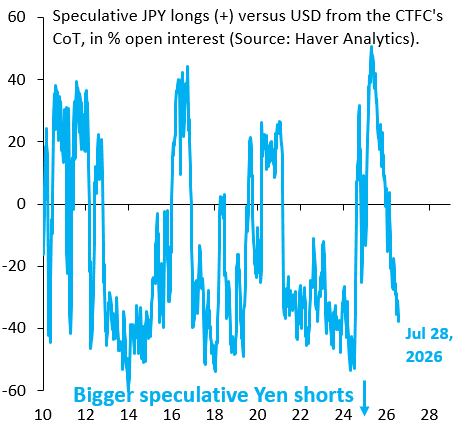
All that said, speculative Yen shorts had grown very stretched ahead of this week’s intervention. The chart above shows data from the CFTC’s Commitment of Traders (CoT) report, which suggests speculative shorts were near all-time highs despite the risk of imminent intervention. This explains the short-term relief in $/JPY, but it’s not a reason to expect a sustained rebound in the Yen. If anything, markets will see this as an opportunity to short the Yen at a better entry point.
The bottom line is that - as long as Japan’s government bond yields are artificially capped - the Yen is overvalued and needs to fall. Only allowing yields to rise freely can fix this and Japan can’t afford to do that because this’ll spark a debt crisis.
Two fiscally irresponsible countries helping each other be more fiscally irresponsible. Brings a tear to the eye.
Just as you predicted — so I’m watching the FX chart move with nothing but sheer astonishment