
Thank you for subscribing to my posts. If you’re not yet a paying supporter, please consider becoming one. That’ll allow you to DM me with questions and comments. Your contribution will help cover the cost of the data I use in my posts, which I fund out of my own pocket. Thanks so much for your support and feedback!
Kevin Warsh gave a hawkish keynote at Jackson Hole on Friday and markets moved quickly to raise the likelihood of a 25 basis point hike in September. In normal times, this would be bad for gold and the debasement trade, but we’re no longer in normal times. Today’s post explains why Friday’s “hawkish” shift from Warsh is actually good for gold and other precious metals, which means they should reverse Friday’s sell-off in relatively short order. The big picture is highly supportive of the debasement trade.
When it comes to US policy these days, the tail wags the dog, by which I mean that much of what the government does is driven by the need to fund the massive deficit at affordable interest rates. This is why Warsh had to sound hawkish on Friday. A repeat of his dovish performance on July 29 would have risked re-igniting the bond market sell-off that’s plagued the government ever since and forced the Treasury to announce highly unusual buybacks to get things back under control. The Treasury and the Fed have joined forces to keep long-term yields from spiraling out of control, which is what I called a new Treasury-Fed accord in yesterday’s post and live stream.
Now think about what all this means for the debasement trade. The reason to hike is to tighten financial conditions and slow domestic demand. Financial conditions are most obviously a function of the 10-year Treasury yield, which is disproportionately important as it drives mortgage rates and thus the housing market. A September hike - if it comes to pass - will happen to anchor the 10-year yield and avoid a repeat of the bond market sell-off after July 29. Its purpose will therefore be the opposite of what a traditional hike aims to do and is why the debasement trade will continue to do well. A September hike, if that’s where we end up, will be performative, with the principal aim of keeping financial conditions loose.
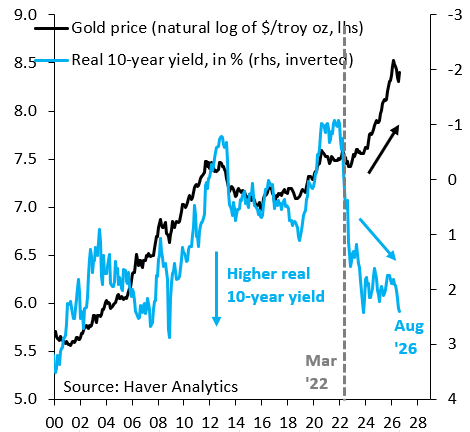
What does all this mean for gold? The black line in the chart above is the monthly average for the price of gold starting in January 2000. The blue line is the real 10-year Treasury yield, which is shown on the right axis on an inverted scale. If this line falls, it means real rates are rising. Since this is the opportunity cost of holding gold, that’s bad for gold prices and you can see this broadly holds over time. A rise in the real 10-year yield tends to see gold prices fall.
If I’m right that we’re witnessing the emergence of a new Treasury-Fed accord, the purpose of which is to cap longer-term yields, that’s bullish for gold because it caps the upside for real interest rates. In fact, it’s even more than that. A few weeks ago, I did a series of posts about “shadow yields,” which is where yields would be without all the government intervention that happens across much of the G10. The more shadow yields rise as US debt keeps growing, de facto yield caps will just fan the flames of the debasement trade. So Friday’s hawkish speech by Kevin Warsh isn’t a bearish signal for gold and a Fed hike in September won’t be such a signal either. Out-of-control debt is driving everything these days and it’ll drive gold higher.
Suspect the raie will be after the election..
Any attempt to suppress long-term interest rates is bullish for gold. We might see periods of volatility like we did a few months ago, but in my view only structural policies can create a genuine long-term bear market.