
Thank you for subscribing to my posts. If you’re not yet a paying supporter, please consider becoming one. That’ll allow you to DM me with questions and comments. Your contribution will help cover the cost of the data I use in my posts, which I fund out of my own pocket. Thanks so much for your support and feedback!
Yesterday was a bad day in global markets. Longer-term bond yields jumped sharply as strong US data encouraged markets in their belief that the Fed is behind the curve and needs to tighten a lot more. At the same time, the world’s energy markets are very unsettled. The front-month futures price for Brent, the global benchmark for oil, rose even as the Saudi East-West pipeline is about to restart amid the rapid rise in oil flows out of the Persian Gulf as Iran loses control of the Strait of Hormuz. The rise in Brent is fanning fears around the high level of gasoline and diesel prices worldwide, but - in the run-up to the midterms - anxiety is especially high in the US.
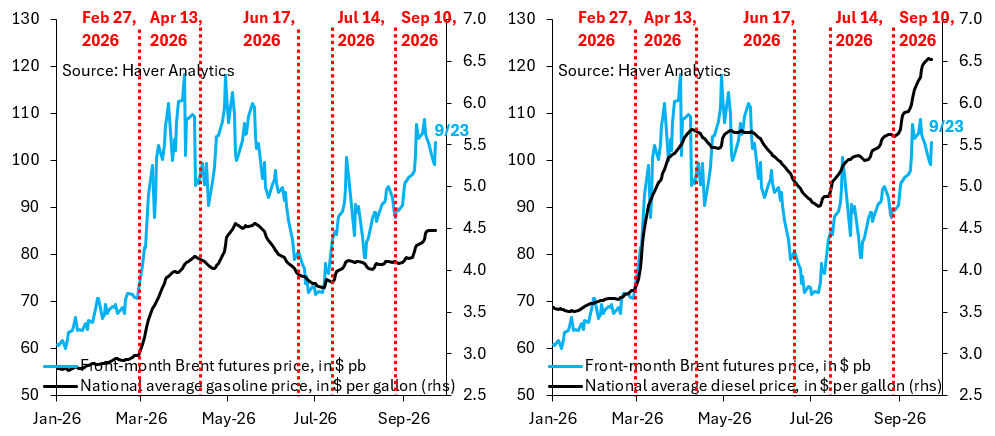
The two charts above zero in on the rise in US gasoline (left) and diesel (right) prices. The blue line in both charts is the front-month Brent futures price and has its values on the left axis. The black line in the left chart is the national average price in the US for one gallon of gasoline, while the black line in the right chart is the same thing for a gallon of diesel. For the latter we’ve surpassed the highs seen earlier this year, which is why there’s now mounting chatter about a diesel export ban. Today’s post is a quick Q&A on the key questions around such a ban.
Will it happen? There’s lots of unknowns and unintended consequences with this kind of thing, so you can’t just impose a ban willy-nilly. If there’s a ban, domestic diesel prices will fall and refinery storage tanks will fill up. As a result, refineries will cut back on diesel production. Gasoline is often produced alongside diesel, so you could end up with higher gasoline prices, which is the last thing you’d want to have happen ahead of the midterms. There’s lots of tricky details like this that need to be weighed against demands from US farmers for a ban. Ultimately, it all comes down to how much pressure the White House feels into the midterms. My best guess is that a ban doesn’t happen unless diesel prices spike a lot further.
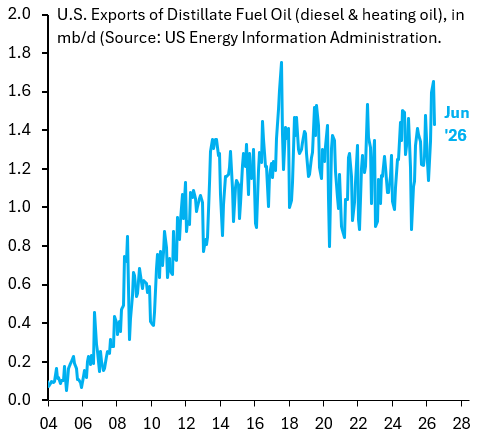
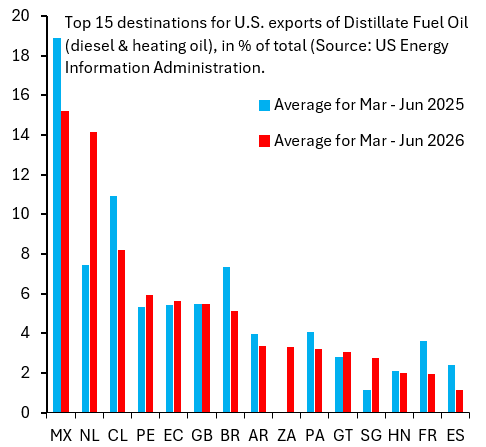
Who gets hit by a ban? The chart above shows monthly data on US distillate fuel oil exports, which is largely diesel. On average in the March to June 2026 period, i.e. since the war with Iran has been ongoing, the US exported 1.4 mb/d. Global demand is 28 mb/d, so the US is five percent of this. The chart below shows who the most important export destinations are. Latin America would get absolutely hammered by a ban, with Mexico (MX), Chile (CL), Peru (PE), Ecuador (EC) and Brazil (BR) very exposed. The Netherlands (NL) as an energy logistics hub for all of Europe and the UK (GB) would also get hit. In fact, there’s a chance a diesel export ban could tip Europe into recession, which could then spill back to the US, another unintended consequence that makes rapid adoption of a ban unlikely.
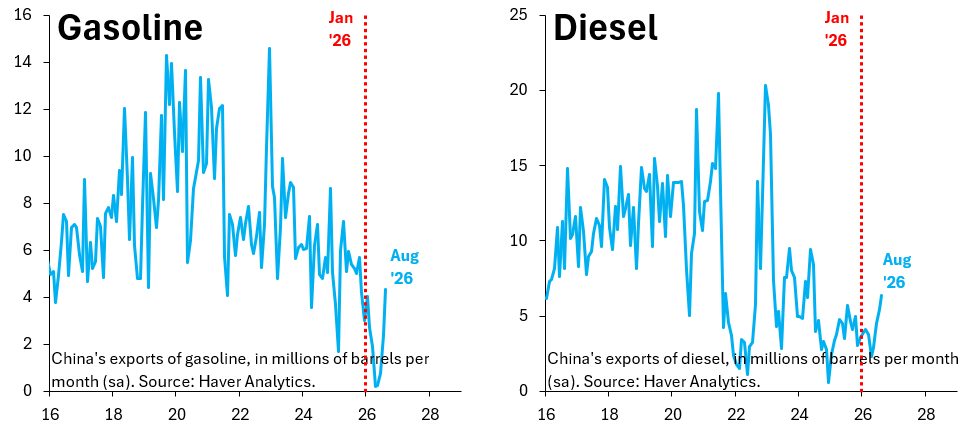
Could China help instead? President Trump meets President Xi today. China has massive refining capacity and could easily ramp up exports. Indeed, as the chart on the right below shows, its gasoline exports are very low recently and the same is true for diesel in the chart on the right. Markets are speculating a deal could involve higher Chinese exports in return for the US turning a blind eye to the Pacific. I don’t put any stock in this for the simple reason that China would never trust such a deal. After all, how could it be sure the US will honor its side of the bargain after the midterms. China won’t be helping the US.
My bottom line is that a diesel export ban at current prices is unlikely. My base case is for Brent to resume its decline, which should help anchor diesel prices.
What stayed with me is how a policy aimed at lowering one price can end up creating pressure somewhere else. The diesel–gasoline connection is a good reminder that energy markets are much more interconnected than they often appear.
Two thoughts: 1. ".. Iran loses control of the Strait of Hormuz..". How is that measured? Traffic for tankers and bulk carriers through the strait as of today is still only fraction of the pre-war average, and the threat of Iran shooting at ships is still very much alive. And that's all it takes to make ship owners, insurers and crews say "No thanks!" or charge a very high risk premium.
2. Why ban exports, when you can charge an export tariff that has the same effect and generates income for the Treasury? After all, this President likes tariffs, as he states frequently.