Super weird markets since Jackson Hole
Powell's dovish speech on August 22 gave a massive boost to gold, but nothing else

I recently wrote a longer post about how weird markets have been so far in 2025. Things have gotten much weirder since then. Chair Powell gave a very dovish speech on August 22 at Jackson Hole. Markets correctly understood the signal and priced an additional 25 basis points in easing through the end of next year. You’d have thought that would weigh on the Dollar, lift the S&P 500 and boost commodity prices across the board. But that hasn’t happened. The only thing that’s moved is gold, with a massive price rise of almost 10 percent.
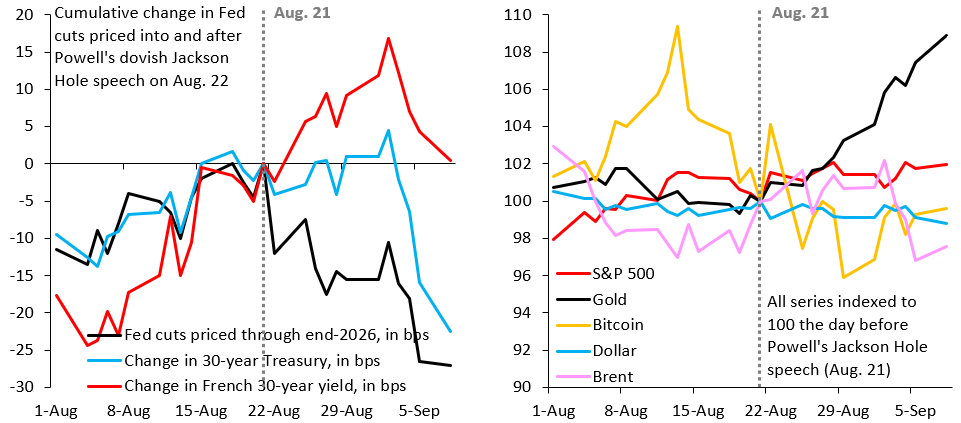
The two charts above show what’s been going on. The left chart shows the cumulative change in market pricing for Fed cuts (black line) through 2026 into and after August 21 (the day before Powell’s speech). The chart also shows the cumulative change in the 30-year Treasury yield (blue line) around August 21 and the cumulative change in the French 30-year yield (red line). Markets immediately priced more Fed easing after Powell’s speech, but that didn’t pull down the 30-year Treasury yield until weak payrolls this past Friday (Sep 5). The fact that the 30-year Treasury yield didn’t fall immediately is weird and worrying. It took very weak payrolls to finally do that.
The right chart shows key asset prices. Remarkably, the Dollar (blue line) has been stable since Powell’s speech, which is counterintuitive, as you’d think expectations of more Fed easing to weigh on the greenback. Bitcoin (orange line) and the S&P 500 (red line) have also been largely unchanged. The only winner has been gold, which is now up almost 10 percent since the Powell speech.
What does all this mean? Recent market moves suggest gold is the ultimate safe haven. Bitcoin is proving too volatile and speculative, so - as political pressure on the Fed mounts - markets gravitate to gold. At the same time, it’s possible that the crisis in France caused safe haven buying of the Dollar, which would explain why it’s been stable even as the Fed made a major dovish shift. If that’s the case, the Dollar has more short-term downside as it catches up with dovish Fed pricing.
The bottom line is that there’s a lot of things in markets that don’t currently hang together well at all. The key question that hovers over all of this is whether the rise in gold prices signals a structural break - as we move more and more towards the US losing reserve currency status - or if it’s just noise that mean reverts. My guess is the latter, as my readers will know, but it’s just a guess.
" just noise that mean revert" ? Such a (big) noise makes history. When gold double it's value...
What does it matter what gold does in this environment of no distress? Why is gold a safe asset when no safety is required? Gold is bought so price went up… wait till we have distress, then observe safe heaven assets (dxy and treasuries)