What Demand Destruction Actually Looks Like
Oil price alarmists foretold terrible supply disruptions, but the data tell a different story

Thank you for subscribing to my posts. If you’re not yet a paying subscriber, please consider becoming one. That’ll allow you to DM me with questions and comments. I plan to move my posts behind a paywall in coming months. Subscribing now locks you in at a low rate. Thank you so much for your support and feedback!
The past three months has seen all kinds of apocalyptic oil price forecasts, similar to 2022 after Russia’s invasion of Ukraine. I’ve pushed back on such forecasts, which in my view are really just lobbying against any kind of measure that disrupts the ability of the global oil industry to make money. The G7 oil price cap on Russia is such a measure. The US blockade on Iran is another.
Implicit in these apocalyptic forecasts is the assumption that oil stops flowing to key places, so there’ll be acute shortages. As a result, prices must spike to crazy levels to “destroy” demand. The closure of the Strait of Hormuz is a “natural experiment” that allows us to look at what actually happens in practice. Asia is the epicenter of this “natural experiment” and - fortunately - a bunch of countries in the region publish high-quality trade data in a very timely manner. I recently used Chinese data on exports to countries in the Persian Gulf to show that the US blockade of Iran is working well. In today’s post, I use South Korean data on oil import volumes to show that the supply crunch was actually quite modest. Import volumes from Saudi Arabia fell, but South Korea just imported more oil from the likes of Canada and Malaysia. It no doubt had to “pay up” to do this, but - by doing so - it was able to almost fully offset the Strait of Hormuz shock. The lesson is that markets are way more resilient and resourceful than apocalyptic oil price forecasts give them credit for. Hopefully, this “natural experiment” will banish these kind of nonsense forecasts going forward.
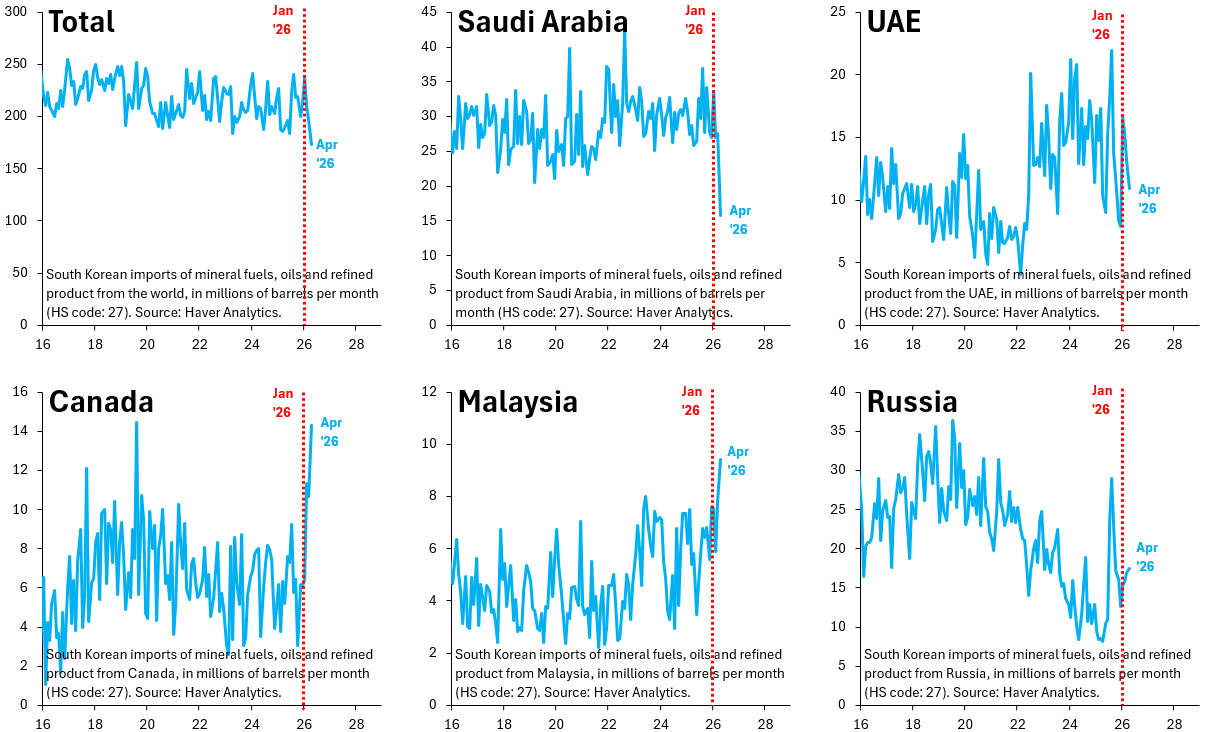
The panel of charts above shows monthly data on South Korean import volumes of oil and refined product. The top left chart shows total imports from all countries globally. The top middle chart shows imports from Saudi Arabia. The top right charts shows imports from the UAE. The bottom row - going from left to right - shows imports from Canada, Malaysia and Russia. The basic story is that total imports of crude did fall, but that fall is relatively modest and certainly not apocalyptic. There’s a big drop in imports from Saudi Arabia, but that’s almost fully offset by a rise in imports from Canada and Malaysia. South Korea “paid up” to keep the supply of oil flowing while the Strait of Hormuz was shut.
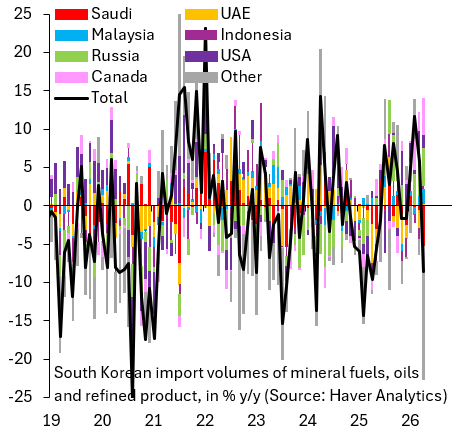
The chart above summarizes what happened with South Korea’s oil imports. The black line shows year-over-year growth in oil import volumes, while the bars show the contributions to this growth from different countries. There’s a big drop in imports from Saudi Arabia (red bars) and “other” (gray bars), which most likely reflects other Persian Gulf countries like Kuwait and Iraq. But imports from Canada (pink bars), Russia (green bars) and Malaysia (blue bars) rose to almost fully offset this.
The bottom line is that this supply shock really wasn’t all that traumatic. That’s also why oil prices didn’t have to rise to apocalyptic levels. There just wasn’t all that much demand that needed to be “destroyed.”
I think this largely misses the point? The argument for higher oil prices going forward is that given the pace of inventory drawdowns, there will be a point at which shortages happen which will lead oil prices to sky rocket the, not before. Oil prices reflect fundamentals, not expectations. That South Korea substitutes Middle Eastern oil imports is irrelevant to this claim, and crucially doesn’t tell you how long they can keep doing it…
This analysis seems to be myopic and created to support the administration in this stupid human killing destructive war. The line that says the
American blockade is working is laughable.