Why does Brazil keep playing with the bad guys?
It's baffling Brazil has joined China, India and Turkey in ramping up imports from Russia

After Russia invaded Ukraine, the Western game plan was pretty clear. Russia’s economy depends critically on energy exports. The central idea was to starve it of hard currency inflows via the G7 oil price cap and restrict access to Western technology by way of export controls. On both fronts, a major challenge has been that big emerging markets - foremost China and India - have helped Russia circumvent these measures.
It’s pretty obvious why China wants to help Russia. First, the invasion of Ukraine is putting on full display just what a pitifully weak geopolitical actor the EU is. Second, war in Ukraine is visibly straining the transatlantic relationship, with US impatience mounting as Europe flails. Third, as long as German industry reels from higher energy costs, this gives China an advantage in any trade dispute with the EU. In short, there’s many reasons why Beijing wants to prolong the war in Ukraine as much as possible.
I guess there’s also a reasonable explanation for why India bought so much Russian oil off shadow fleet ships. India is a massive energy importer and the temptation of cheap Russian oil was just too good to pass up. The same goes for Turkey, which is another big energy importer. But why has Brazil joined this dubious group of countries?
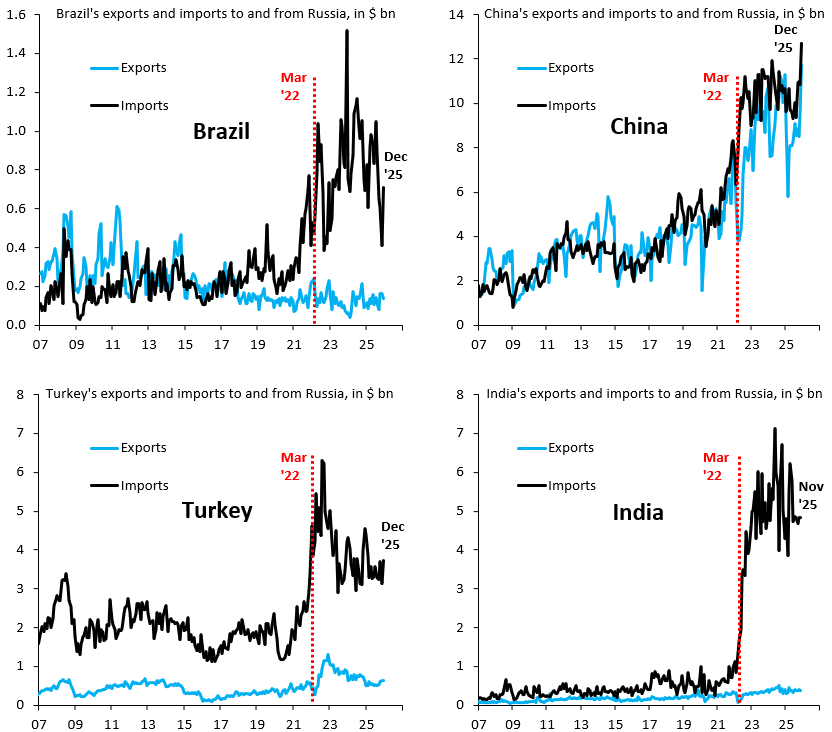
Each of the four charts above shows monthly trade with Russia for Brazil (top left), China (top right), Turkey (bottom left) and India (bottom right). In each case, the blue line shows monthly export values to Russia, while the black line shows import values from Russia. In each case, the denomination of exports and imports is the same and is in billions of US Dollars per month.
Imports from Russia have risen massively across the board. In most cases, the bulk of this is about oil and - since oil prices are basically back down to pre-COVID levels - this is about a massive rise in import volumes. China is in a league of its own, India and Turkey are similar, and Brazil is - admittedly - a lot smaller. But the same ramp up in volumes is clearly also a factor for Brazil, which means implicit support for Putin.
It’s baffling what Brazil hopes to get out of this. Putin is entirely transactional and will barely remember Brazil’s imports a few years from now. Indeed, ramped up trade with Russia will just bring geopolitical headaches for Brazil. The world is fragmenting and voters in advanced economies are growing more distrustful of emerging markets. Now just isn’t a good time for these kind of mixed messages from Brazil.
I have a bone to pick with you on one of your assertions: You write: ” war in Ukraine is visibly straining the transatlantic relationship, with US impatience mounting as Europe flails.”
This seems like a misrepresentation. I have never known the EU — and Europe, more broadly — to move with such pace and resolve as on this matter (in a relative sense obviously). If you’re referring to the problem of shadow fleets and Russia’s foreign reserve assets, then surely you know that the Union’s decision-making process requires full consensus, i.e., agreement before action is taken. So look to Greece for the former, and Belgium, Italy, Hungary for the latter. That’s the sand in the gears.
Also the way you phrased it, you appear to delivering an apologia on behalf of the US. The US’s impatience? There has been no aid (financial or military) to Ukraine in Trump’s second Administration. There have only been sales. Since Ukraine doesn’t have the money, Europe has to buy the weapons that it cannot produce from the US and send them to Ukraine. This is the classic protection racket that we have come to expect. The US’s impatience therefore is not out of concern for the freezing Ukrainians. It is for more European funds to fatten the US’s mammoth defense industry and more jobs in that sector and more profits for its stockholders.
There’s other aspects of this. Much of the refined products sold by russia to brazil have been bought by shady distributors controlled by organized crime. That was exposed recently by a police investigation.