Japan's Interest Rate Disaster
Without constant BoJ buying, Japanese long-term yields would be in the double digits

Thank you for subscribing to my posts. If you’re not yet a paying supporter, please consider becoming one. That’ll allow you to DM me with questions and comments. Your contribution will help cover the cost of the data I use in my posts, which I fund out of my own pocket. Thanks so much for your support and feedback!
Japan is in a terrible spot. Its gross public debt is so high that the Bank of Japan (BoJ) is forced to keep buying government bonds on a constant basis, because - without this action - longer-term bond yields would rise uncontrollably, pushing Japan into a debt crisis. But artificially capping yields puts depreciation pressure on the Yen, because - in the absence of an adequate risk premium - markets exit Japan. This is why official FX intervention or GPIF repatriation flows can’t possibly hope to stabilize the Yen. The root cause of Yen depreciation pressure is too much debt. Only debt reduction will end the currency debasement cycle Japan has been in since COVID.
The million Dollar question in all of this is how much higher Japan’s government bond yields would be without BoJ yield caps. After all, if we’re talking about ten or twenty basis points, this is hardly worth worrying about. But if we’re talking about a few percentage points or more, things get scary very quickly given that Japan’s gross public debt is 240 percent of GDP. Today’s post tackles this question. In my opinion - without constant BoJ bond buying - Japan’s longer-term yields would be in the double digits. Japan is de facto in a very serious debt crisis.
This isn’t just an issue for Japan. The ECB in 2022 enthusiastically capped Italian and Spanish government bond yields and introduced a new tool - the TPI - that helps keep those yields artificially low on an ongoing basis. We know from a “natural experiment” in 2022 - President Lagarde slipped in a press conference and said it’s not the job of the ECB to cap yields - that these countries’ yields would be MUCH higher without all this. There’s artificially low yields and hidden debt crises all over the place.
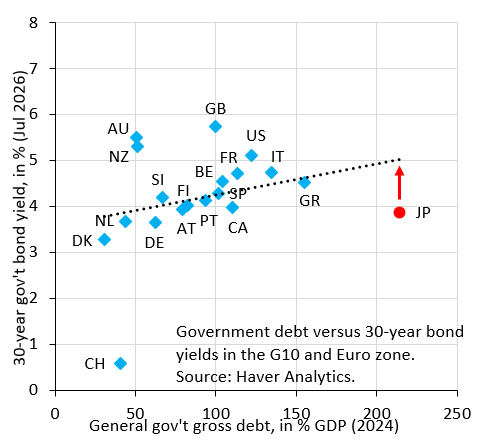
The vertical axis in the chart above shows the latest data for 30-year government bond yields across the G10, while the horizontal axis shows gross public debt in percent of GDP in 2024. The dotted line shows there’s a positive association between the level of long-term yields and the scale of public debt, but not a massively strong one, by which I mean that the slope of this line is pretty flat. If you take this line at face value, it says that Japan’s 30-year yield should be about 100 basis points above its current level.
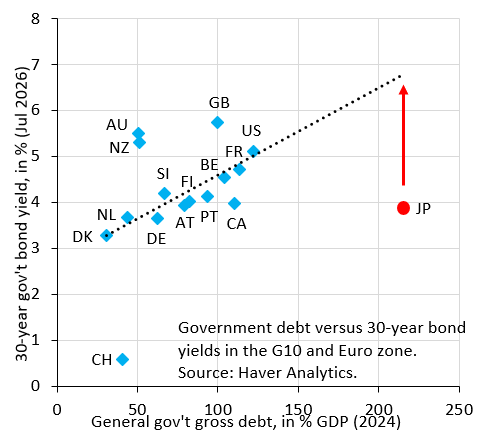
There’s a big problem with the first chart and its dotted black line, which is that it’s contaminated by central bank actions to cap yields. That should be obvious from the data point for Japan, but - as I point out above - artificially low yields are a common feature across high-debt Euro zone countries as well. The chart above drops Japan, Greece, Italy and Spain - the most egregious yield caps in the sample - and plots the dotted line that results from this “cleaner” data set. This suggests Japan’s 30-year yield should be 300 basis points higher. In my view, this still substantially underestimates how much higher yields should be. The “cleaned” sample has lots of countries where central banks bought government debt in substantial size - including the US, the UK (GB) and France (FR) - which means the slope of the dotted would be steeper still if I properly controlled for all this activity. The bottom line for me is that Japanese long-term yields would be in the double digits without the BoJ.
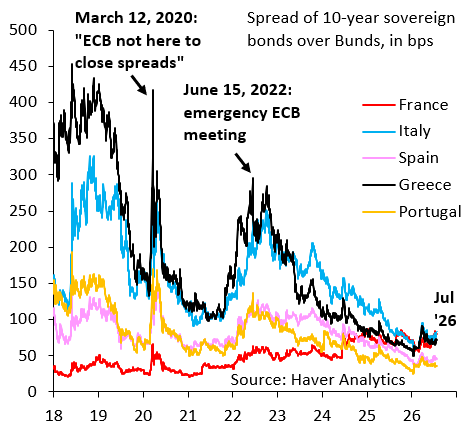
If that sounds nuts, it isn’t. The ECB “natural experiment” from March 2020 shows why. President Lagarde slipped in that month’s press conference and said the “ECB is not here to close spreads.” As the chart above shows, the spread of periphery 10-year yields over German Bunds spiked immediately and would have gone a lot wider had the ECB not announced emergency QE to cap spreads. In my view, periphery yields would have been in the double digits within days had this not happened. The idea that Japan’s shadow 30-year yield - the yield without BoJ yield caps - could be ten percent or higher is therefore quite plausible.
I now completely understand why interventions or capital repatriation by the GPIF are utterly incapable of stabilising the yen. It makes total sense to me.
Thank you very much for precious explanation.
Nice read Robin. Isn't a big factor that the BOJ has been purposefully behind the curve with their rate hikes due to scar tissue of decades of no inflation? There is a credible thesis that the BOJ could play catch up and hike more aggressively than the market expects with; inflation persisting, evidence the economy can handle higher rates (albeit slightly higher), and acknowledgement weaker JPY is hurting households. These are just a few factors but thoughts on the potential of a more hawkish BOJ?