Why have precious metals tumbled?
In this post, I run through various explanations for why precious metals have tumbled

Precious metals have tumbled since war broke out in the Persian Gulf. In today’s post, I run through various explanations for what’s going on. There’s three theories that are doing the rounds in markets. First, the crazy run-up in precious metals before the war no doubt sucked in lots of retail investors who didn’t trade things like gold before. It’s reasonable to think that this broader investor base may change how precious metals trade, making them behave more like risk assets rather than safe haven assets. That’s consistent with gold selling off on oil price spikes and rallying - in the last day or two - on expectations of detente. Second, it’s likely that lots of people were sitting on big gains in precious metals. A rise in uncertainty makes you want to take your chips off the table, so people - reasonably - may have locked in some of those gains. Third, the rise in volatility put other positions - especially in the hedge fund community - under water. That kind of thing means people get hit with margin calls, for which they need liquidity. That might see them sell profitable positions to free up cash. Gold will have been one of those positions. I don’t think any of these things invalidate the safe haven status of gold nor the debasement trade. They do signal that the buyer base may have broadened, which is why we’re seeing atypical price action now.
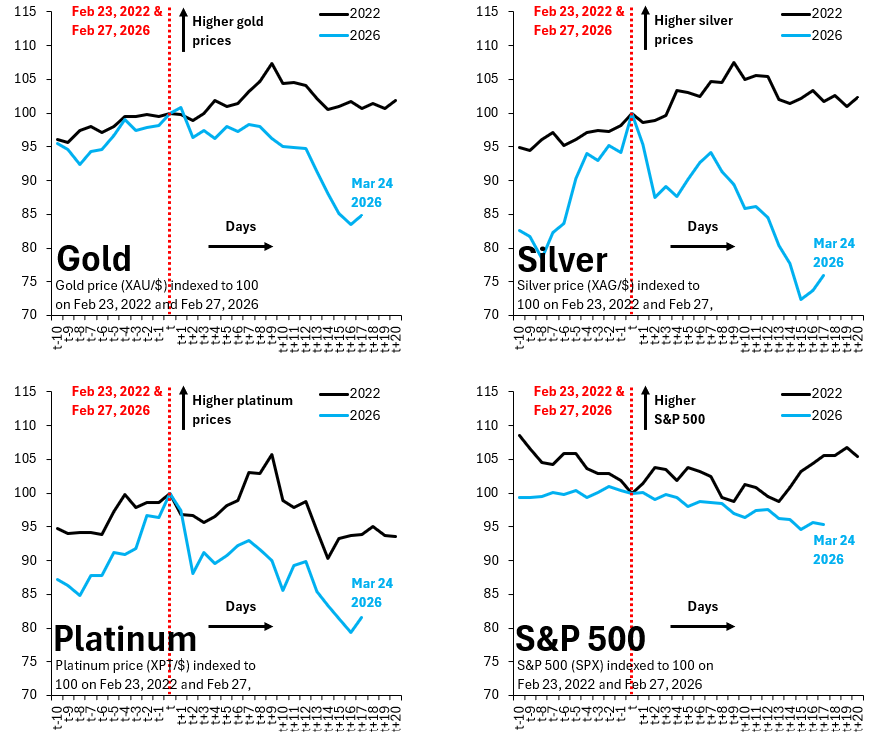
The four charts above show price action in gold (top left), silver (top right), platinum (bottom left) and the S&P 500 (bottom right) since the start of hostilities in the Gulf. I compare current price action to what happened after Russia’s invasion of Ukraine in 2022, to give historical perspective in a similar kind of shock. A couple of points are worth making. First, all precious metals are down since the outbreak of war. Gold is down 15 percent, silver is down 25 percent and platinum is down 20 percent. To put this in perspective, the S&P 500 is down five percent over the same period. Precious metals have thus clearly underperformed. Second, a fall in the S&P 500 of five percent hardly qualifies as a big risk-off, which means that the safe haven status of gold won’t have been triggered. That makes me inclined to think recent declines are a vestige of the huge run up in precious metals prices and positioning. Third, Russia’s invasion of Ukraine didn’t really trigger much of a rally in gold or other precious metals and the S&P 500 - on a similar time scale - is almost identical to now. That again leans in the direction of this being a positioning purge.
My favored explanation for the recent sell-off is that the crazy run-up in precious metals has broadened the investor base. It’s possible that this - at least right now - is making precious metals trade more like risk assets, which would explain why they fell as the conflict escalated and - in recent days - rallied as signs of detente emerged. It’s also likely that high volatility hit some parts of the market hard. It’s not unusual for profitable positions to get liquidated when people get hit with margin calls for trades that are under water. Lastly, it’d be perfectly reasonable for people to lock in gains as uncertainty rises. You take your chips off the table when you don’t understand what’s going on. None of these explanations invalidate the debasement trade, of which I’ve become a fan. After all, fiscal policy in the US and elsewhere is just as reckless as before the war, so the search for safe havens from debt monetization will persist.
I think it’s because (1) get out of profitable positions for liquidity and (2) something to do with the dollar rising and the dollar being more safe haven since war began
Do you thinks that this sell-off could also be because countries east of Suez like Japan, South Korea, India, Thailand, the Philippines, that depend on Gulf crude and refined product may be selling to off-set the rising costs or is it an exaggeration to say that?