Another Benign Inflation Print
There's just no way the Fed will hike with the kind of inflation readings we're getting

Thank you for subscribing to my posts. If you’re not yet a paying supporter, please consider becoming one. That’ll allow you to DM me with questions and comments. Your contribution will help cover the cost of the data I use in my posts, which I fund out of my own pocket. Thanks so much for your support and feedback!
My North Star on inflation is that we’ve had all kinds of supply shocks in recent years - COVID supply chain disruptions, Russia’s invasion of Ukraine and now the war with Iran - yet underlying inflation has stayed well behaved. That to me says the hurdle for inflation to take off is high and - if anything - we should be concerned about building disinflationary pressures coming from AI and all the disruption it’s going to cause to white-collar employment.
Markets take a different view. They went into the July FOMC meeting pricing ten basis points in hikes, quite remarkable given that core inflation for June had fallen sharply just a few weeks earlier. As I noted yesterday, all the recent hand-wringing about inflation strikes me as political. Markets are trying to push Warsh into hiking because they think he’s under orders from the President to cut. As long as markets keep this up, they’ll get right-sized by data and yesterday’s CPI report for July was part of that. Markets revised down the odds they put on a September hike, but they did so grudgingly and continue to price more than a full hike by the end of 2026.
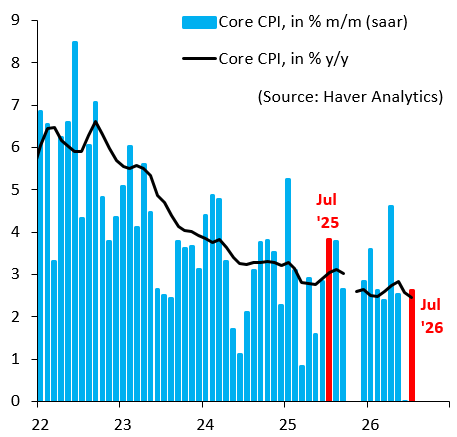
On the surface, yesterday’s CPI wasn’t amazing. The black line shows year-over-year inflation. The blue bars are month-over-month inflation, which I annualize so it’s on the same scale as the year-over-year numbers. You can think of the black line as a 12-month moving average of the blue bars. The only reason the black line fell in July is because the monthly inflation impulse in July 2025 - which dropped out of the year-over-year number - is bigger than the latest impulse. That’s what nerds like me call a “base effect” and is very unexciting.
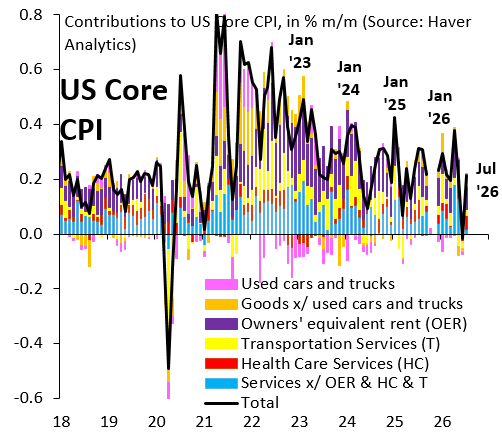
But there’s much more going on under the hood. The black line in the chart above is month-over-month core inflation, so it’s the same as the blue bars in the chart above (only now there’s no annualizing). Core has lots of noisy stuff in it, so the blue bars are my preferred tracker for what’s really going on. They represent 30 percent of core and are what’s left after you drop owners’ equivalent rent (purple), healthcare (red) and transportation (yellow). This “core of core” was flat in July after being slightly negative in June. There’s a lot more disinflation once you look under the hood, so - in my view - all the hand-wringing about inflation is misplaced.
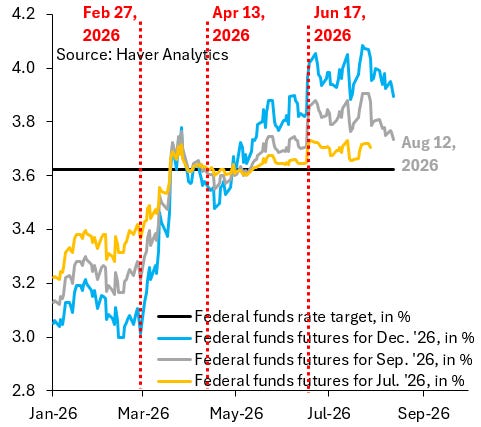
Which brings us to market pricing. The black line in the chart above is the midpoint of the Fed’s 25 basis point range for the policy rate. The orange line is what markets were pricing into the July meeting. The gray line is what they price for September and the blue line is what’s priced through the end of 2026. Markets yesterday correctly saw the data as dovish and reduced their expectations for hikes. But they did so reluctantly and we’re still pricing 11 and 29 basis points, respectively, for September and through the end of the year. Markets are determined to stick with their hawkish narrative for what the Fed should do, which means “the beatings will continue until morale improves.”
The idea that the Fed might not hike rates this year (though the current debate around CPI centres on whether to hike, rather than rate cuts) does not automatically mean the Bank of Japan (BoJ) can afford to delay a rate increase in September or October.
The BoJ’s rationale for hiking rates is fundamentally domestic. According to the BoJ’s own projections, core inflation is set to accelerate well above 2% from September onwards—a domestic trigger entirely independent of the Fed’s actions. Furthermore, if the Fed stays on hold and US yields remain elevated, the yield differential will fail to narrow, leaving downward pressure on the yen intact. Given the transmission mechanism of a weaker yen leading to higher import inflation and, subsequently, heightened concerns at the BoJ over overshooting inflation, the logic might actually work in the opposite direction.
From another angle—one aligned with the fiscal dominance thesis—if the BoJ decides there is no urgency to act, it risks creating a paradoxical outcome: prolonging yen weakness and merely kicking the can down the road regarding unrealised losses on fiscal accounts and insurance balance sheets. While the market has scaled back the probability of a September rate hike, it continues to price in more than one full rate increase by the end of 2026.
Just as political manoeuvring around Kevin Warsh may be distorting the Fed's rate-hiking cycle, the dynamic between a Takaichi administration and the BoJ should perhaps be viewed through a similar lens. Rather than a straightforward correlation where "the BoJ won't move because the Fed isn't moving", it is more accurate to view both central banks as playing out parallel yet independent dramas, each torn between domestic political pressure and local economic data.
Inflation is transitory since 2021… but still well above the target. The FED will slowly but surely lose credibility