China is Winning
China's export sector has emerged massively strengthened from the US tariff stand-off

Thank you for subscribing to my posts. If you’re not yet a paying supporter, please consider becoming one. That’ll allow you to DM me with questions and comments. Your contribution will help cover the cost of the data I use in my posts, which I fund out of my own pocket. Thanks so much for your support and feedback!
In the 3D game of chess we call the world, China is winning right now. I’m a China “hawk” for a number of reasons. For one thing, China has consistently played the role of global destabilizer since Russia’s Ukraine invasion in 2022. It’s only thanks to how much it’s ramped up its exports that Putin’s war economy hasn’t completely imploded. This is also why I’ve been pushing back on the silly market narrative that China acted to cap global oil prices in recent months. That misreads trade data - China imported less because it has a large stockpile it could draw on, just like Japan and South Korea - but, more importantly, it hopelessly misreads China’s intentions, which most certainly aren’t to do the US any favors. You just have to think back to last year’s stand-off over rare earths to know that. For another thing, China’s is doubling down on its beggar-thy-neighbor export model. It’s flooding the world with electric vehicles (EVs) and a false narrative of its own “green” electrification. None of this stuff is good for the US, let alone the world. Tariffs, export controls and sanctions are perfectly justified.
So it pains me to say that China’s export sector has emerged strengthened from last year’s tariff stand-off with the US. Exports to the US are almost back to where they were at the end of 2024, so there’s no indication US tariffs had any discernible effect. On top of that, exports to every other country have risen massively. China is literally flooding the world with stuff. Today’s post documents this for key countries around the world. Tomorrow’s post follows that up with a look at export prices, which have rebounded sharply since the US rolled back its China tariffs. The bottom line is that China’s export sector is now doing very well after really struggling in 2025.
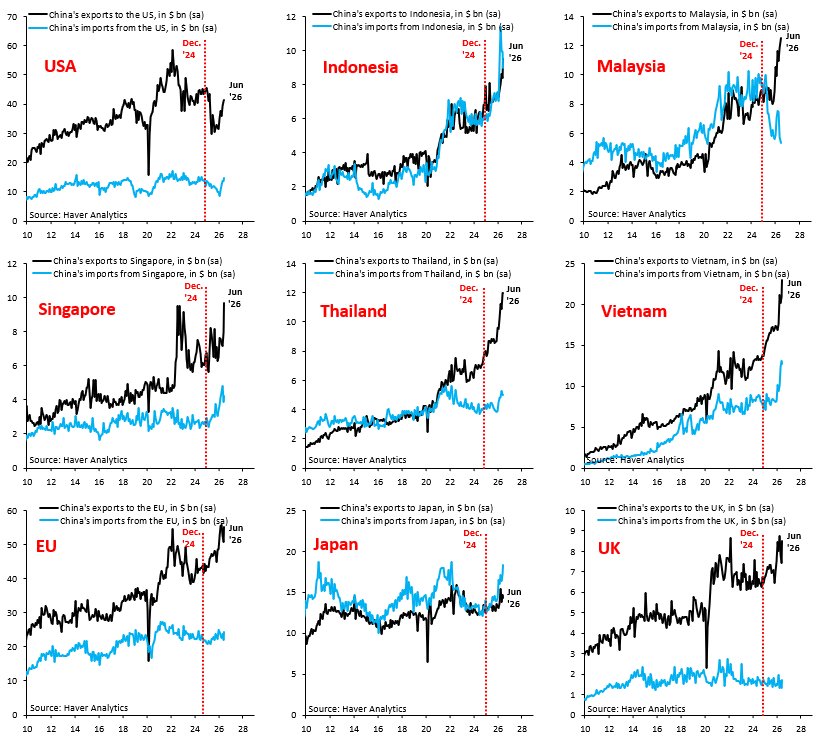
The black lines in the charts above show China’s monthly exports to nine countries for which it publishes seasonally adjusted data. The blue line in each chart is China’s imports from each of these countries. The vertical red line marks December 2024, i.e. just ahead of the start of President Trump’s second term. There’s three points that are worth making. First, China’s exports to the US (top left) are almost back to where they were before the US raised its tariffs in early 2025. There’s no lasting damage. Second, China’s exports to everywhere else have ramped up massively over the past year. The only exception is Japan. Third, there’s a lot of “China Shock 2.0” out of the EU, but its actually to emerging markets like Thailand or Malaysia that China’s exports are rising most. That’s important because there’s little the EU can do about this. China is taking over traditional EU export markets for things like cars. Even if the EU gets around to imposing tariffs, there’s little those will do to get China out of these markets.
There’s more to all this than just export volumes. US tariffs forced China’s exporters to cut prices so they’d be able to ship to new markets. That hit exporters’ profitability and will have been a deflationary shock for China. All that has gone into reverse since the US scaled back its tariffs. Export prices have rebounded sharply. I’ll write about this in a follow-up tomorrow. China - for now - is winning.
Even a China hawk like Robin now has to concede that China is winning this round of the trade and industrial competition. Yet the tariffs, export controls and sanctions he supports have failed to weaken China. They have weakened the industrial competitiveness of the United States and Europe while accelerating the diversification of Chinese companies into the rest of the world.
But is China’s export growth really “flooding” and damaging the Global South? Vietnam provides an unusually clear answer.
In the first half of 2026, Vietnam’s exports rose 21%, while imports surged 33.4%. Imports of computers, electronics and components increased 62%, and machinery, equipment, tools and spare parts rose 22.9%. These are overwhelmingly production inputs: semiconductors, electronic components, machinery, equipment and raw materials used to expand factories, upgrade capacity and fulfil future export orders. This is what an accelerating industrialisation cycle looks like.
Vietnam ran a $77.3 billion trade deficit with China, while recording a $75.3 billion surplus with the United States. The symmetry is difficult to miss. China’s surplus with Vietnam is the upstream industrial counterpart of Vietnam’s surplus with America. Chinese components and machinery enter Vietnam; Vietnamese factories transform them into electronics, computers, phones and other manufactured goods for the US and global markets.
China’s rapidly growing exports to Vietnam have not crushed Vietnamese industrialisation. They are helping to power it. Calling every increase in Chinese exports a new “China Shock” misses the actual structure of Asian manufacturing: China increasingly supplies the industrial inputs, while countries such as Vietnam expand their own production, employment and exports around them.
It is understandably fashionable to wish that we had never begun the trade war. Indeed, doing nothing to change policy would seem quite preferable to that clownish liberation day last April that had us putting tariffs on the penguins on Heard Island but not Putin.
I personally wish the trade war had been conducted ALONGSIDE our allies such that China and Russia were everyone’s target. I suspect it would have been easy enough to run it through Congress.
But that was simply not to be since instead of fighting to extract terms from the world’s most predatory economy, the regime of course opted for chaos & corruption.