
Thank you for subscribing to my posts. If you’re not yet a paying supporter, please consider becoming one. That’ll allow you to DM me with questions and comments. Your contribution will help cover the cost of the data I use in my posts, which I fund out of my own pocket. Thanks so much for your support and feedback!
Yesterday’s surprise announcement by the US Treasury that it’s increasing buybacks of longer-dated bonds sent two clear signals. The first is that the recent rise in long-term yields - which had risen to their highest level in over twenty years - was crossing an important pain threshold for the US. The problem with this kind of action is that you show your hand, which is what’s now happened. The second and by far the more important signal is that there’s zero willingness to confront the underlying problem, which is that fiscal policy is running out of control and there’s an urgent need to reign in the deficit. Instead, yesterday’s announcement is a form of financial engineering that papers over mounting stress in the Treasury market.
Indeed, yesterday is the clearest sign yet that the US is following Japan on its path towards currency debasement. When fiscal policy is out of control, governments can obviously do many things to cap yields, but this just puts depreciation pressure on the currency because markets don’t get paid the kind of risk premium they desire. What would be a debt crisis thus morphs into a currency crisis, which is why the Yen has been falling for so many years.
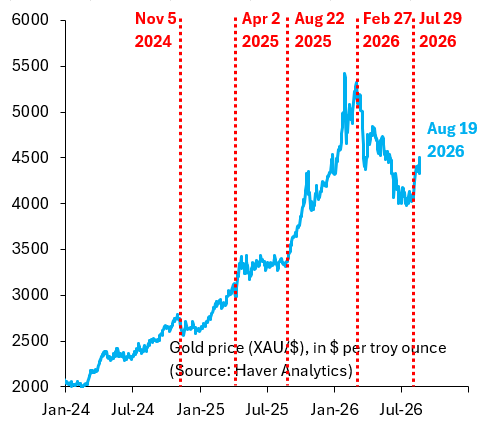
Markets have completely internalized this. Following yesterday’s news, the Dollar fell sharply and is down to its lowest level versus emerging markets (EM) this year, in line with my prediction for Dollar weakness in 2026. The “debasement trade” has also been making a comeback since the Fed meeting on July 29. Gold and other precious metals saw big gains yesterday. What this price action means is that markets are primed for debasement, which is what yesterday’s announcement boils down to. The US Treasury is playing with fire. As Japan shows, once you go down this road, it can be hard - if not impossible - to stop your currency from falling.
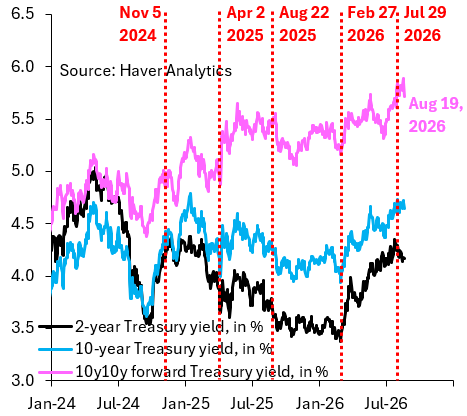
The key question is whether the Treasury got good bang for the buck yesterday. I’m not sure it did. The chart above shows the US yield curve. The black line is the 2-year yield, the blue line is the 10-year yield and the pink line is the 10y10y forward yield, which is what’s been pushing higher recently. This thing fell, but the drop isn’t going to impress anyone. The upward trend in long-term yields is clearly still in place.
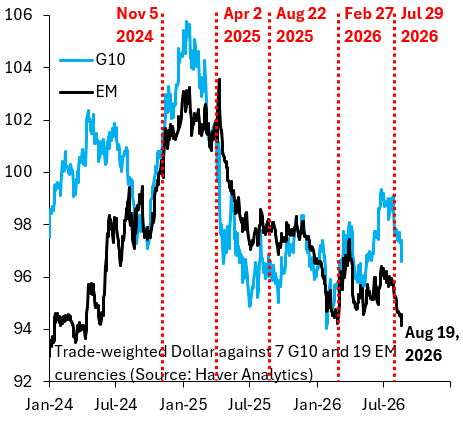
Meanwhile, as the chart above shows, the Dollar absolutely cratered against the G10 (blue line) and EM (black line). Furthermore, as the chart below shows, gold jumped yesterday, as did other precious metals. Markets are primed for Dollar debasement to resume and - as Japan shows - it can be next to impossible to stabilize a currency once it enters a devaluation spiral. The US is playing with fire with this buyback.
The Japan parallel breaks down where it matters. Japan debases against itself — JGBs are overwhelmingly domestic, the BoJ holds over half, and Japan is the world’s largest net external creditor, so a weaker yen is mostly an internal transfer. The US is the opposite: roughly $9.3trn of Treasuries held offshore, close to 30% of debt held by the public. Debasement here is a real-terms haircut on foreign creditors — and unlike Japan’s, they have an exit.
That exit is gold rather than another currency: ~1,000t a year for four years against a 500t prior decade, and a record 45% of reserve managers say they’ll add more. But the shift is slower than the headline suggests — gold passing Treasuries was price, not flow, and the COFER dollar share actually rose to 57.1% in Q1. The dollar doesn’t need central banks to sell. It only needs them to stop reinvesting at the margin.
It’s nothing close to JPY debasement, it’s a disaster to USD.
is it still correct for you to tell us that we shouldn’t panic? that the administration’s federal reserve and its actions towards fiscal and monetary policy is heavily politicised?
the only correct response to the orange man and his cronies of capitalistic leeches is sounding the alarms and buying hard assets.