Debunking Misinformation from the Oil Bulls
The $200 oil crowd has gone very quiet, but it's still spreading lots of misinformation

Thank you for subscribing to my posts. If you’re not yet a paying supporter, please consider becoming one. That’ll allow you to DM me with questions and comments. Your contribution will help cover the cost of the data I use in my posts, which I fund out of my own pocket. Thanks so much for your support and feedback!
You’d think that with Iran and the US falling back into a “hot” war, the $200 oil crowd would be up to their old tricks, but they’re oddly quiet at the moment. That silence is deceptive because they’re still spreading lots of misinformation that aims to obfuscate why their forecasts were so off. There’s two “urban legends” this crowd is pushing right now. The first is that the Strait of Hormuz was never actually closed, so oil continued to exit the Persian Gulf, even when we were told otherwise. That’s total nonsense. It’s a fact that oil tanker transits almost completely ceased in March and April. We’re now getting official data from countries in the Gulf that provide independent verification of this, which I’ll show in this post. The second is that China prevented oil prices from spiking by cutting its imports. That’s a gross misrepresentation of what happened. All countries in Asia with meaningful stockpiles, including Japan and Korea, cut imports and ran down inventories at the worst points in this shock. China isn’t special, quite apart from the fact that it has zero interest in helping the US by capping oil prices.
The reason I think oil bulls are behind this stuff is because both “excuse” why Brent didn’t go to $200. That worries me because this misinformation muddies what actually happened, which is that the peak in oil prices - around $125 - was right around where academic estimates for the price elasticity of demand put it given the closure of the Strait. It’s all pretty plain and simple, as I explained on Paul Krugman’s podcast back in March. No wild conspiracy theories needed!
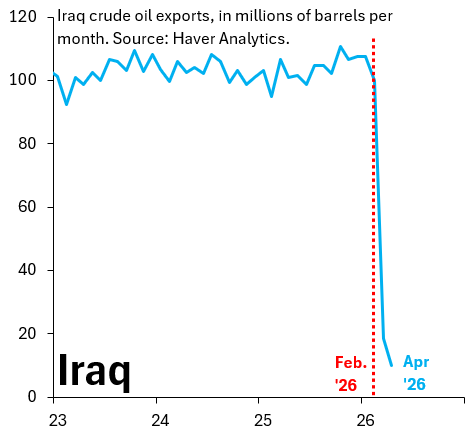
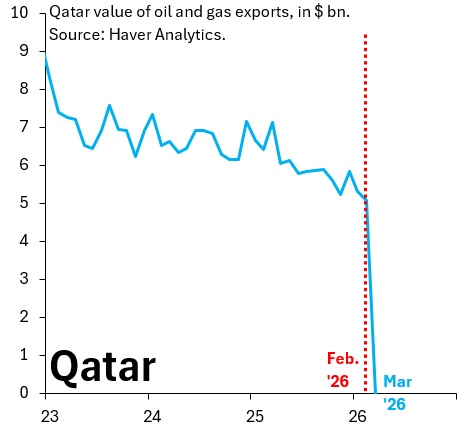
The Strait was never closed: you’d be shocked how often I hear this. This kind of misinformation gets going because there’s only very few companies that track oil tanker activity and their data are prohibitively expensive to access. But we’re now getting official data from Gulf countries, which give us independent verification of what happened. The chart above shows how Iraqi oil exports fell to almost zero in April 2026, which for now is the latest data point. The chart below isn’t quite as good. It shows oil and gas export values - so price times quantity - for Qatar. The sharp rise in prices will dampen any fall, but - even so - exports went to zero in March 2026. The idea that the Strait didn’t close is terrible misinformation.
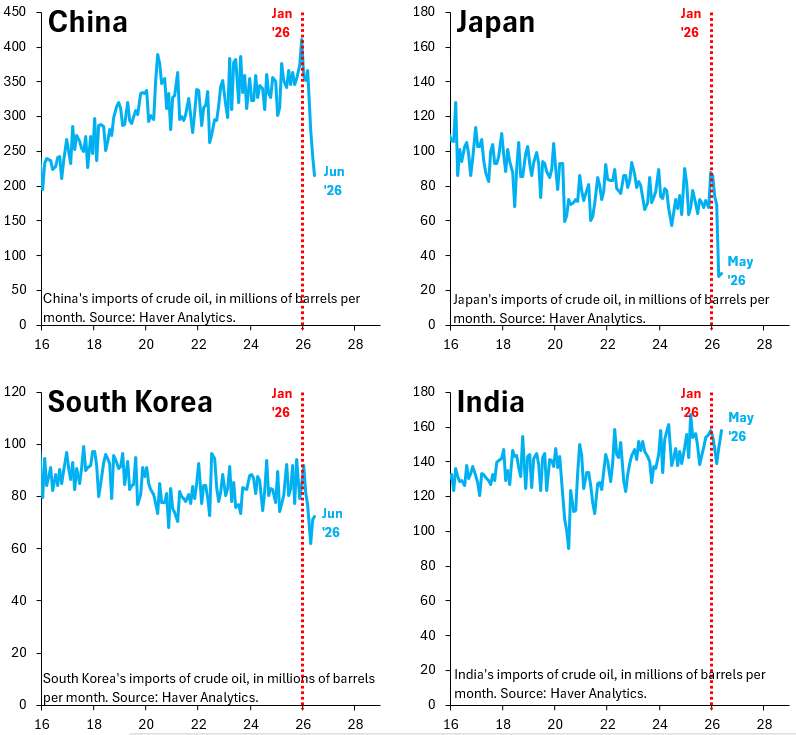
China is the reason oil didn’t go to $200: the idea that China single-handedly capped oil prices is almost comically wrong. I’ll not belabor the point here, since I’ve written about it extensively, but here’s the basic gist. Anyone who had large stockpiles of oil drew on those in March and April when oil prices were at their highest. The panel of charts below shows that China did so, but Japan and Korea did too. The outlier in Asia is India, which didn’t have large inventories and thus had to keep importing. It was able to do this thanks to US sanctions waivers on Russian oil. China is therefore part of a broader pattern whereby countries with large stockpiles used those to ride out this shock. China isn’t unique.
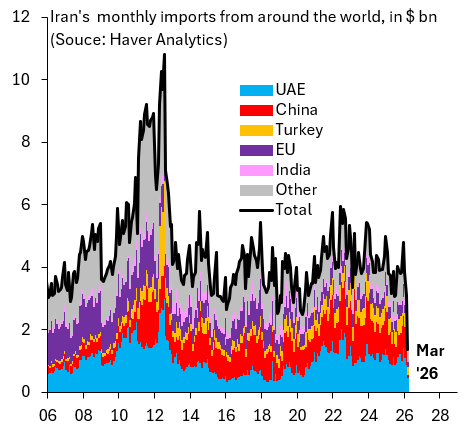
In my opinion, this kind of misinformation is dangerous because it gets a lot of play in markets. I hear both points made in meetings all the time and they’re up there with all the bashing of the US blockade of Iran, which is another standard talking point from the same crowd. I’ll end by pointing out that the US is enforcing the latest iteration of the blockade much more aggressively than its first incarnation. Empty oil tankers that belong to Iran are being disabled so they can’t be used as floating storage and key port and storage infrastructure is being disabled. These things will help make Blockade 2.0 hit Iran faster than Blockade 1.0. That’s important because Iran’s imports of goods fell sharply in March 2026, as the chart below show, which is prior to Blockade 1.0 started. Iran will be suffering full-scale shortages and hyperinflation by now. All the bashing of the blockade and Iran’s supposed asymmetric advantage is in my view nonsense.
This analysis completely misses the physical reality of the market.
First, looking only at headline crude prices ignores the historic high crack spread. Consumers are already paying the equivalent of $140+ for fuel because of a severe refining bottleneck. The oil price didn’t cap at $125 due to "academic elasticity". It was artificially suppressed because the US drained its SPR to tank bottoms and China temporarily stopped importing. Now, those inventories are empty, China is buying again, and the physical deficit is massive.
Second, the shortage of high-sulfur (heavy) crude is acute. Western refiners cannot easily process light sweet crude to make diesel without cutting their utilization rates.
Finally, you underestimate the asymmetric threat. It is not about the size of Iran’s navy. A single drone strike near Bab-el-Mandeb or the Basra terminal will force UK/EU insurers to cancel war risk coverage. That instantly shuts down Saudi and Iraqi exports.
Paper manipulation can only hide a physical shortage of heavy crude for so long. The reality will break through.
Interesting perspective. Thank you. Where I differ from your view would be on refined products which show a different picture. Prices stay high and show stress from capacity tightness. Another point of debate would be on China appetite to continue to take barils out of strategic reserves in the months to come.