Avoid Hyperbolic Alarmism (AHA)
The main investing lesson from the past two years is to avoid alarmist hyperbole

Thank you for subscribing to my posts. If you’re not yet a paying supporter, please consider becoming one. That’ll allow you to DM me with questions and comments. Your contribution will help cover the cost of the data I use in my posts, which I fund out of my own pocket. Thanks so much for your support and feedback!
I’ve been thinking about what lessons there are for investing from the past two years. The first - and by far the most important in my view - is to ignore alarmist hyperbole. Just think back to this time last year when the US losing reserve currency status was hotly debated. No one’s talking about that now and - more importantly - no one takes this topic seriously these days. It’s similar with the $200 oil crowd that was so vocal in March and April. The war with Iran continues to fester and tanker traffic through the Strait of Hormuz is far from normal, but no one takes $200 oil seriously any more. The second is that coverage of the Trump administration - in the media and in the broader discussion - tends to be too negative because it’s politically motivated. I don’t want to sound like I’m defending this administration, but not everything it does is awful. Just think of its Russia sanctions, which have been very impactful, something that always gets omitted from stories about how Trump is beholden to Russia. Or think of recent coverage of the Fed under Warsh, where a lot of the criticism feels political.
The reason this stuff matters is because there’s money on the table. Leaning the other way from the hyperbole means you don’t chase momentum but are a contrarian. You were shorting oil back in March and April and were long the Dollar this time last year. Both things would have made you money. If you tune out the negative coverage of this administration, it’ll be harder to miss that the economy looks reasonably healthy, even after yesterday’s weak retail sales report. You’ll be less inclined to cash out of the S&P 500 and miss what’s been an eye-watering rally. Again, none of this is about defending the administration. It’s about filtering out noise that’s politically motivated.
Let me start with hyperbolic alarmism. There’s no question many of the things this administration does are unorthodox and - sometimes - poorly executed. But the global economy and the position of the US within it are incredibly resilient. That’s the lesson we’ve learned from the past two years.
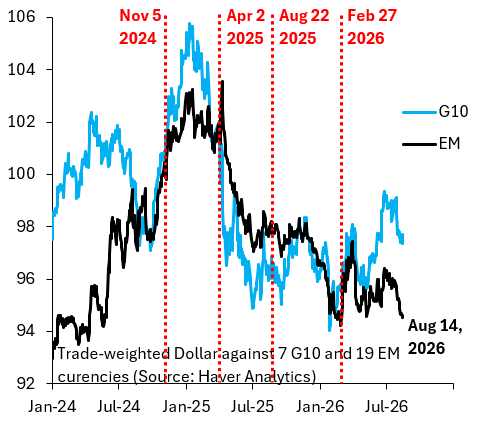
Loss of US reserve currency status: the Dollar fell sharply after what can only be described as a chaotic rollout of reciprocal tariffs, but it’s been much more stable since last summer as the chart above shows. More importantly, reserve managers haven’t piled out of the Dollar. Their allocations to the US have been unchanged from before Trump took office as the chart below shows. This isn’t to say current policies aren’t doing damage. They surely are, but in a very incremental fashion. I should add that I’m a Dollar bear and expect the Dollar to fall around ten percent this year. That’s a cyclical view reflecting my firm belief that the Fed won’t hike and therefore has nothing to do with reserve currency status.
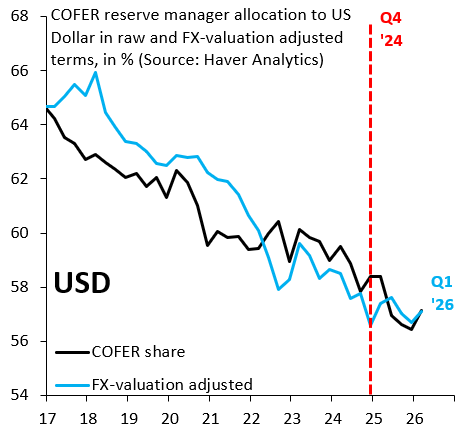
$200 oil: there’s two big lessons from oil not going to $200. The first is that the price elasticity of demand is bigger than most people expected, so there was more demand destruction for a given rise in prices. The second is that supply chains are way more robust than $200 gave them credit for. Countries across Asia pivoted to import oil from Canada and other places, which helped keep their manufacturing going. This spread out globally what would otherwise have been a very localized shock with way more disruption. The fact that $200 didn’t happen makes markets now reluctant to push oil prices higher. That opens the door to complacency and an insufficient risk premium.
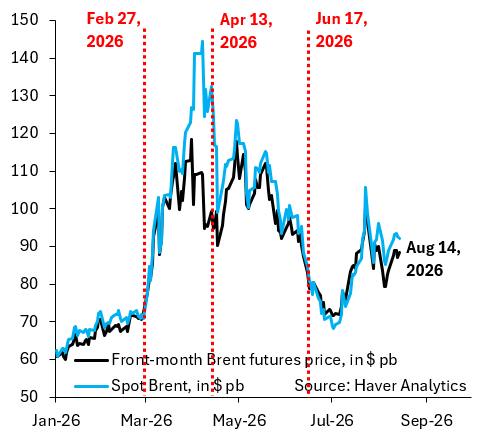
Coverage of the Trump administration is unrelentingly negative. I’m not a fan of many things that are happening either, but not everything is bad. It’s important to look through the political and insider bias that pervades much of the coverage.
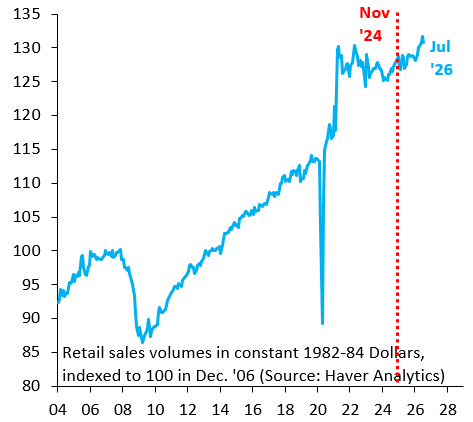
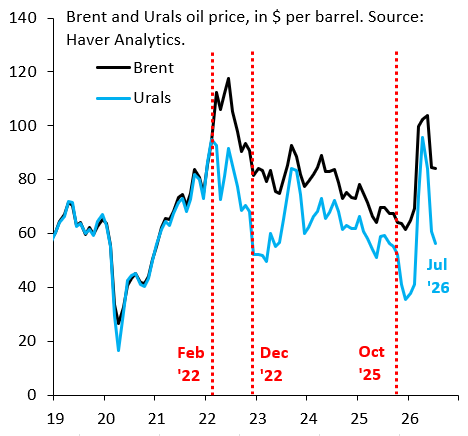
Biased coverage: yesterday’s weak retail sales are a great example how biased things have gotten. The chart above shows retail sales volumes. These did fall in yesterday’s data point for July, but that was after a massive rise in prior months. The truth is that the activity picture in the US is totally fine. Another example is Russia, where the administration’s sanctions on Lukoil and Rosneft in October of last year pushed down sharply the price of Urals versus Brent as the chart below shows. This gets conveniently omitted from coverage of Trump and Russia. The bottom line is that data and actions speak louder than words. Things aren’t nearly as bad as some of the headlines you see.
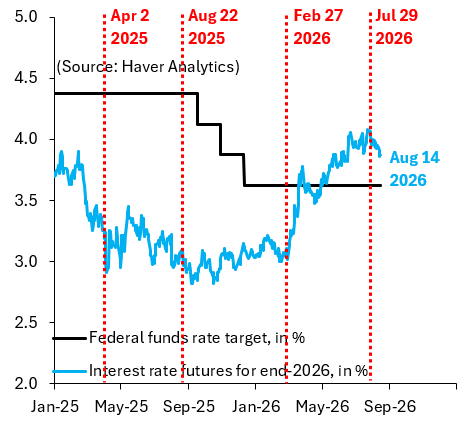
Kevin Warsh: the issue of biased coverage is especially live for the Fed, where it feels like markets see Warsh as someone who promised cuts to Trump and are therefore determined to push him into hiking. That’s a terrible thing for markets to do, because data will always override conspiracy theories. This played out this week with two dovish inflation readings and weak retail sales and - as the chart below shows - markets are starting to pull back on their expectations for hikes.
The bottom line is that the middle of the road is a good place for investors. Ignore hyperbolic alarmism when it comes along and - one thing we can be sure of - there’ll be more of that ahead. Bear in mind also that a lot of chatter on this administration skews too negative. That’s not to say everything that’s happening is great. It definitely isn’t. But many things aren’t quite as bad as they seem or - sometimes - actually better than meets the eye. Just focus on the data and ignore the chatter.
Yeah, I doubt this will age very well. We’re comparing a situation where the world still had lots of strategic reserves to draw down. That’s done and still no SoH. In fact, it’s worse than that with the Houthis at Bab El-Mandeb keeping the Saudis from selling oil that way and the Ukrainians keeping up pressure on Russia.
Even if oil export routes opened up, Russia and the Middle East have lost a significant amount of refinery capacity, which will keep the pressure up on diesel and gas prices. The diesel price of almost $6 right now would ordinarily reflect a $100+ oil price since the crack spreads have gone wild, so to some extent we should instead look to the price of diesel to extrapolate economically and such looks like pernicious inflation is well on the way.
Also, I don’t see how we can continue to claim that the blockade is working to make Iran desperate if they say they’re ok to wait until ‘29 to negotiate the SoH. That was always as optimistic as someone yelling, “hey y’all, watch this!”, just before a self-inflicted trip to the ER.
Completely disagree with this piece.
If you disregarded all warning signs you’d still be stuck holding cash / bills / treasuries. No one truly believes in the inflation figures the Bureau is pumping out and neither does the bond market. There is absolutely a cause for alarm.
If you closed your eyes to where America is heading which to be specific: higher insidious inflation for longer, higher deficits, even more debt: you’d have missed Gold and the debasement trade which will only get louder as term premia continue to blow out. Further, no reasonably sane person would sell mega cap inflation resistant SPX in the face of a mechanically higher deficit, a valueless dollar and AI dynamism which only seems to be investable in the US.
The fact is Trump and his cronies are gutting all American institutions and there is ZERO credibility to what he does and him slapping some sanctions on Russia don’t absolve his sins (I know Ukraine is close to your heart despite the fact the UK having wasted billions of £ that it does not have on the lowest ROI cause).
I have not much to comment on the Oil to $200 narrative. I enjoyed your piece on its demand elasticity back in April, even though i did not put a trade on.